
Labour relations software where every module works from the same record.
Graylark’s modules are not separate tools. Each one reads the same record of your employee representative bodies (ERBs), agreements and people, and writes back to it. An election updates the body. A business case becomes a consultation. Nothing is typed twice.
One change, followed from the first conversation to the last sign-off.
Most employee relations teams run on a map in one spreadsheet, consultations in another and elections in a tool that knows nothing about either. In Graylark each step hands its work to the next.
Know your landscape
Landscape holds your ERBs, their members, your agreements and legal advice by country. Graylark Elect keeps the membership current as each election closes.
Hear about change early
The Change Advisory Gateway brings a planned change to employee relations before it is announced. Business Justification turns it into a decided case.
Consult in every country
Change Proposals starts from who must be informed and consulted where. The EWC Portal runs the European Works Council side under your own agreement.
Carry it through
Reduction In Force plans the people, the cost and the sign-offs, with protected representatives flagged from the Landscape.
Around the work: Conflict of Interest for the register of declarations, Graylark Collaborate for projects and knowledge, and Graylark Academy to train the people doing it.
Landscape
The record of your labour relations that every other module works from.
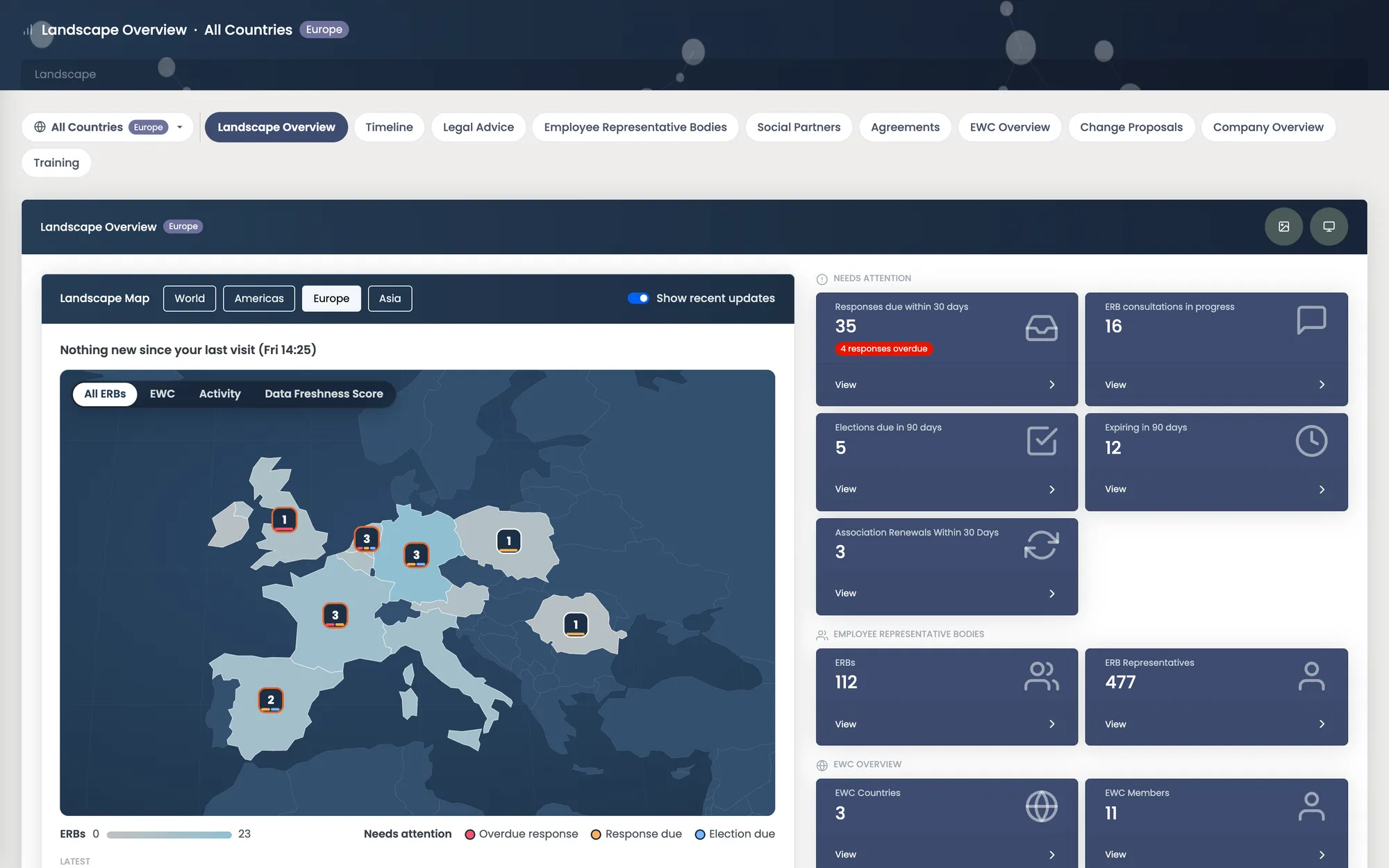
Your employee representative bodies, from works councils and trade unions to your European Works Council, with their members, your collective agreements and your legal advice, country by country. It is the picture you report from, and the data that Change Proposals, Graylark Elect and Reduction In Force rely on.
- Kept current by
- Graylark Elect results, agreement versions and FreshScore reminders
- Read by
- Change Proposals, EWC Portal, Graylark Elect and Reduction In Force
Interactive global map
See your footprint by country in four views: ERB coverage, EWC seats, recent activity and data freshness.
Agreements with AI
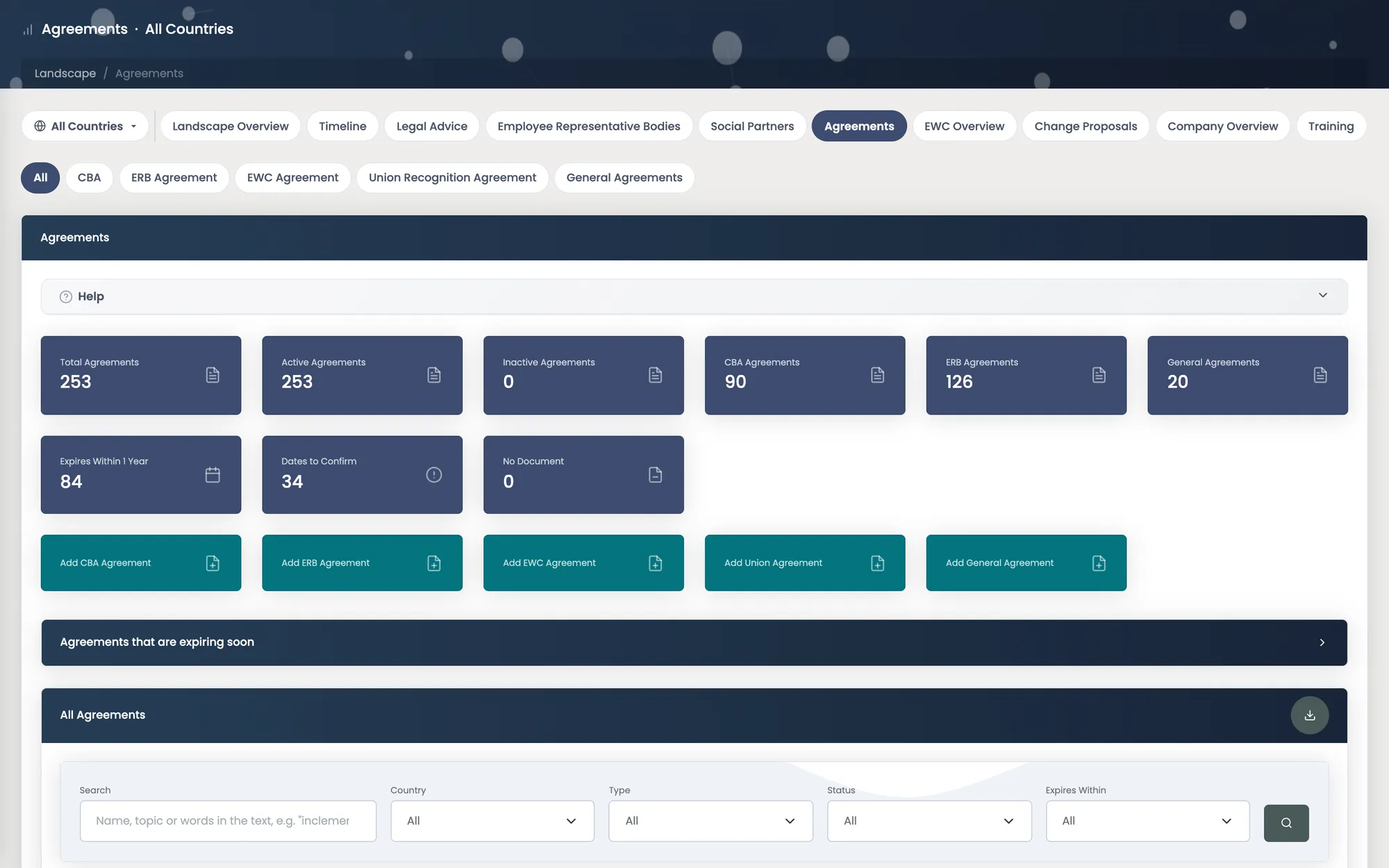
Collective, ERB and EWC agreements with versions and expiry dates. GrAI extracts terms and dates for you to review, compares versions and answers questions from the text.
FreshScore data quality
Colour-coded indicators show which countries have up-to-date data and which need attention, so you always know where to focus.
ERBs and representatives
Every ERB, trade union and representative in one place, with seats and terms. The other modules read this record, so it is maintained once.
Timeline
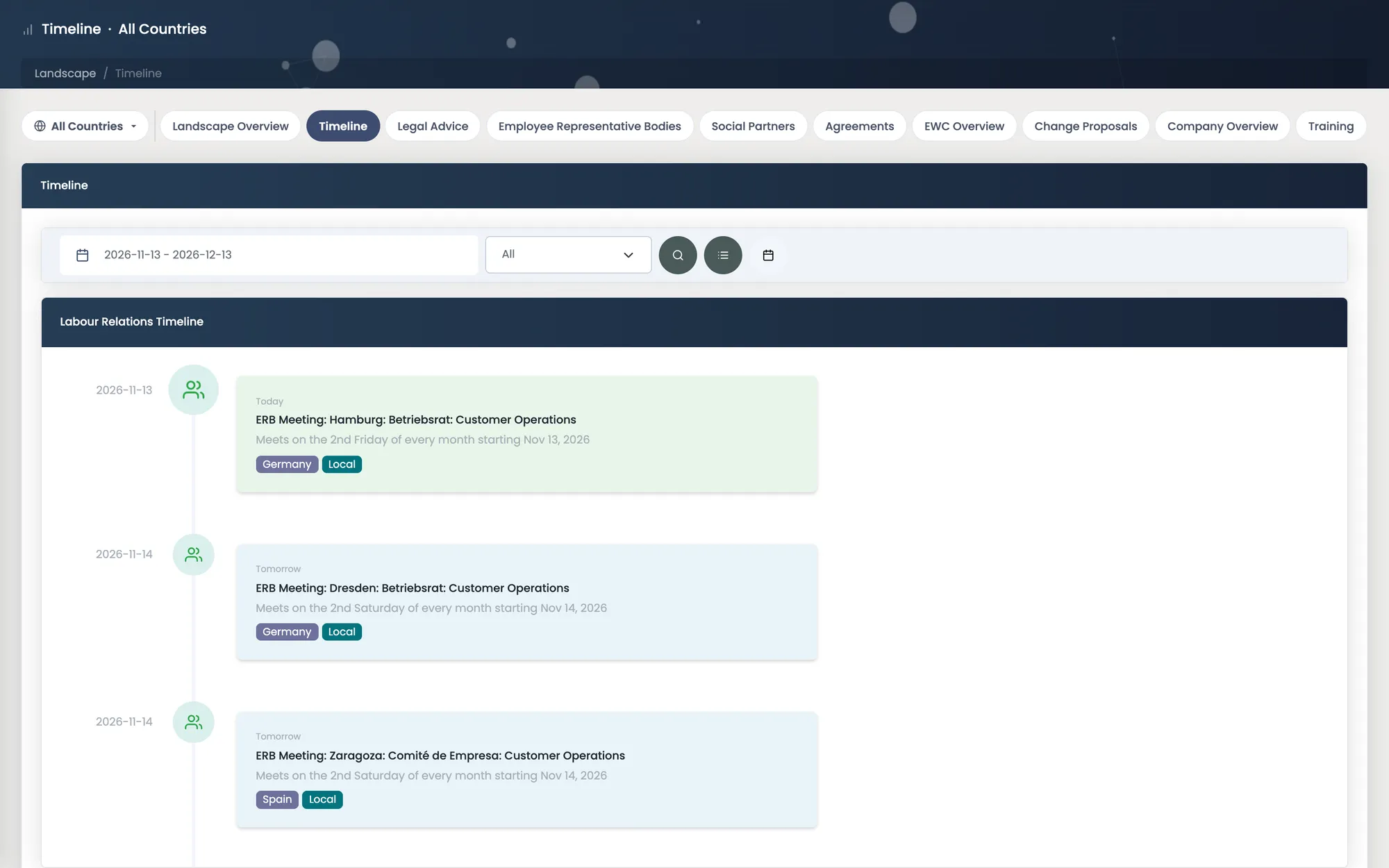
One chronological view of upcoming elections, EWC and ERB meetings, agreement expiries and assessments across every country.
Legal advice repository
The advice you have paid for, searchable by keyword, jurisdiction and trigger event, so the same question is not sent to counsel twice.
Related: works council management, collective bargaining software and labour relations management.
Change Proposals
One change, consulted in every country it touches.
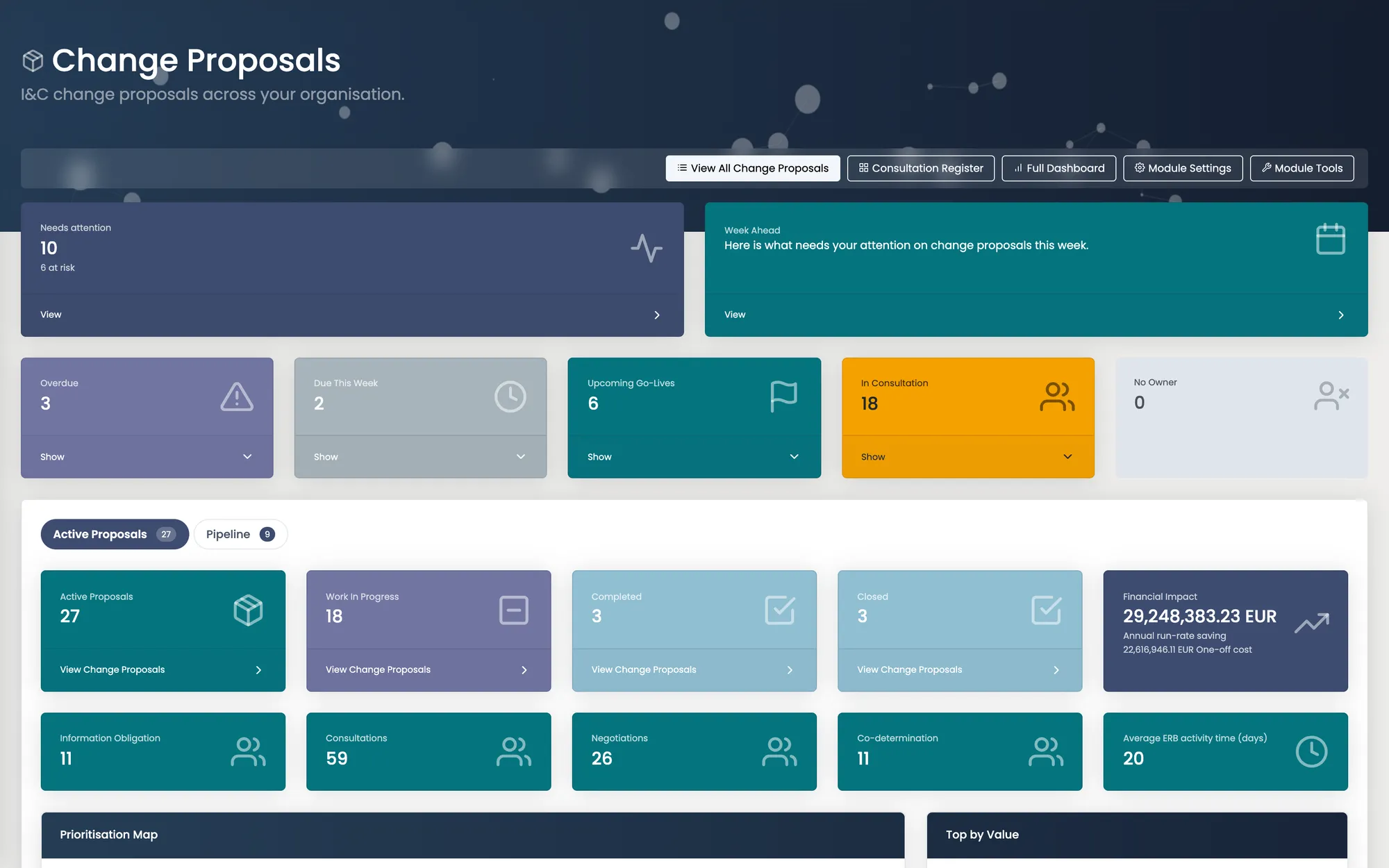
Because Graylark already holds your ERBs and agreements, a change proposal starts from who must be informed, consulted or asked to agree in each country. It then tracks every response, obligation and deadline through to completion.
- Draws on
- ERBs and agreements in the Landscape, advisories from the Gateway, approved Business Justifications
- Feeds
- Each ERB’s activity record and agenda, and the thresholds used by Reduction In Force
Structured proposal lifecycle
A guided wizard, clear statuses, and an audit dossier of every decision and action that can be exported as an evidence pack.
Country response tracker
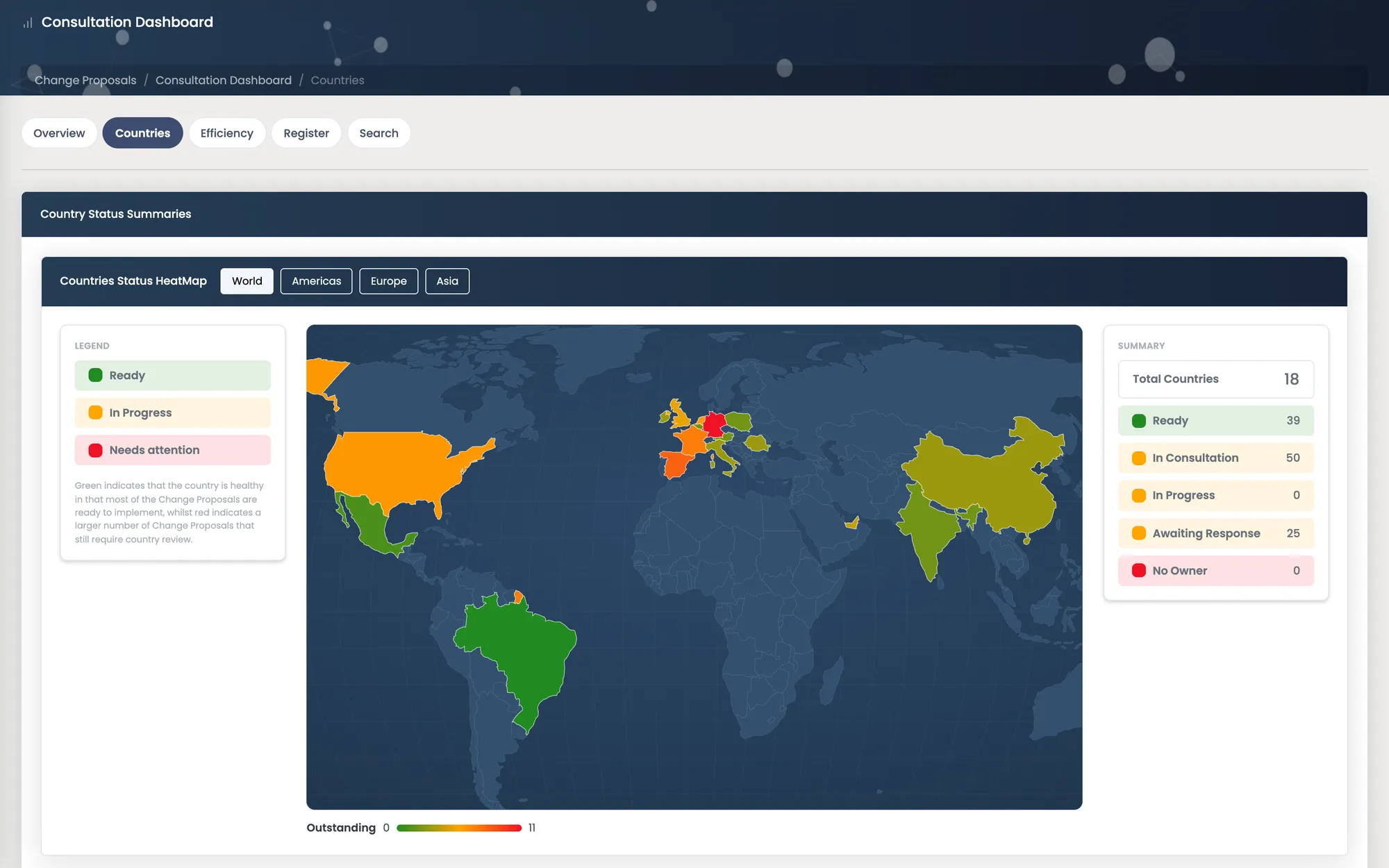
One map shows which countries are ready, in progress or need attention, with each country’s obligations in the tracker beside it.
ERB and union engagement
Record information, consultation, negotiation and co-determination per country and per ERB, drawn from the bodies in your Landscape.
Collective redundancy thresholds
Workforce impact is checked against collective redundancy thresholds held for 38 countries, so a duty to consult is flagged before a date is missed.
Questions from the countries
Countries ask their questions on the proposal itself. GrAI suggests an answer for you to edit, and the answer stays on the record.
Automated reminders
Countries that still owe a response are reminded before and after the respond-by date, so you are not writing chasing emails.
Consultation register
Every obligation across every proposal in one register, with saved views and CSV export.
Dashboards and pipeline analytics
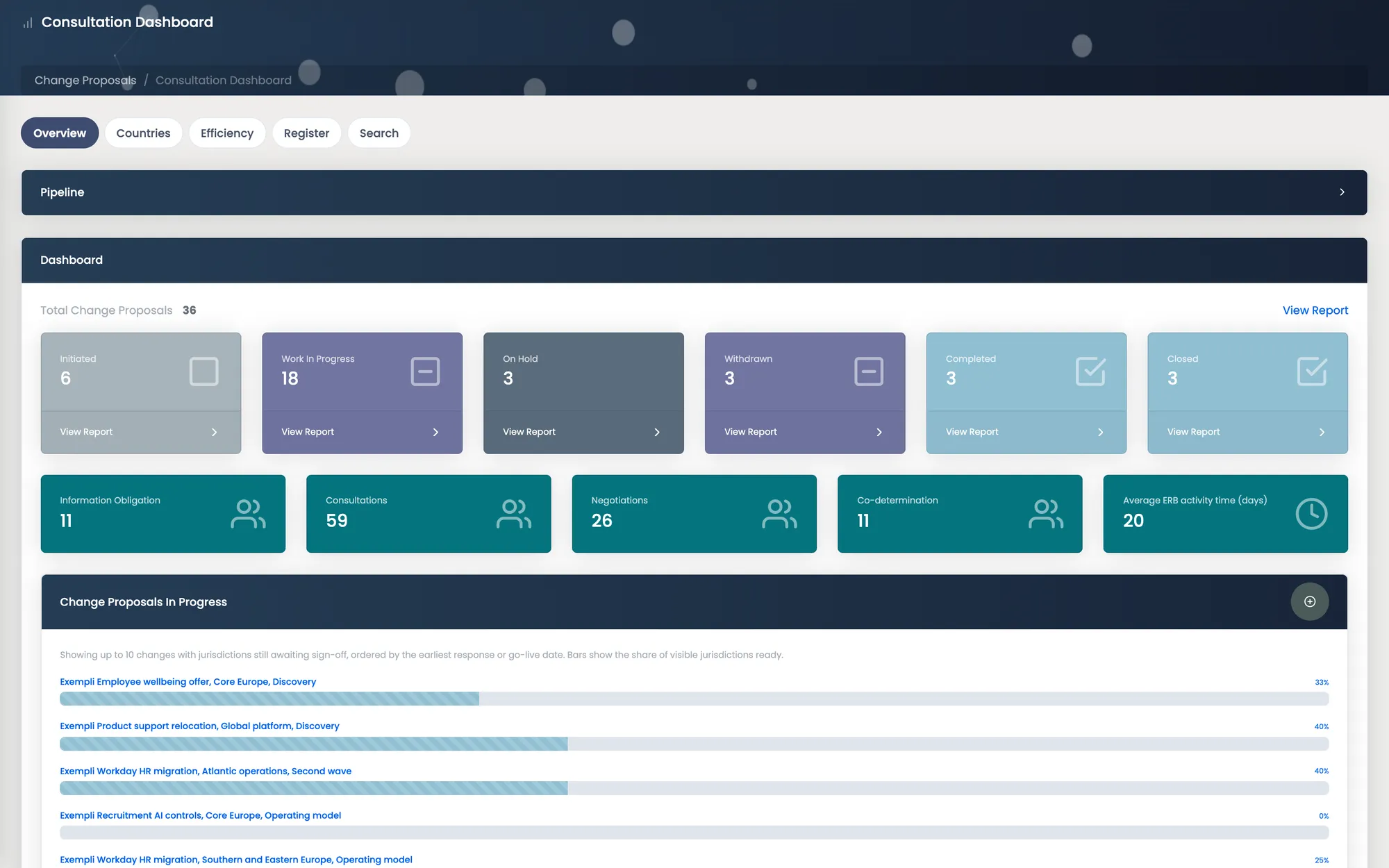
The whole portfolio of changes: duration, conversion, the slowest countries and bodies, and readiness by country.
AI insights
GrAI assesses the likely obligations country by country, analyses documents and drafts the executive summary, all inside Graylark.
Related: change proposal software, cross-border restructuring consultation, consulting on AI rollouts and the consultation readiness check.
EWC Portal
Your European Works Council year, run to your own agreement.
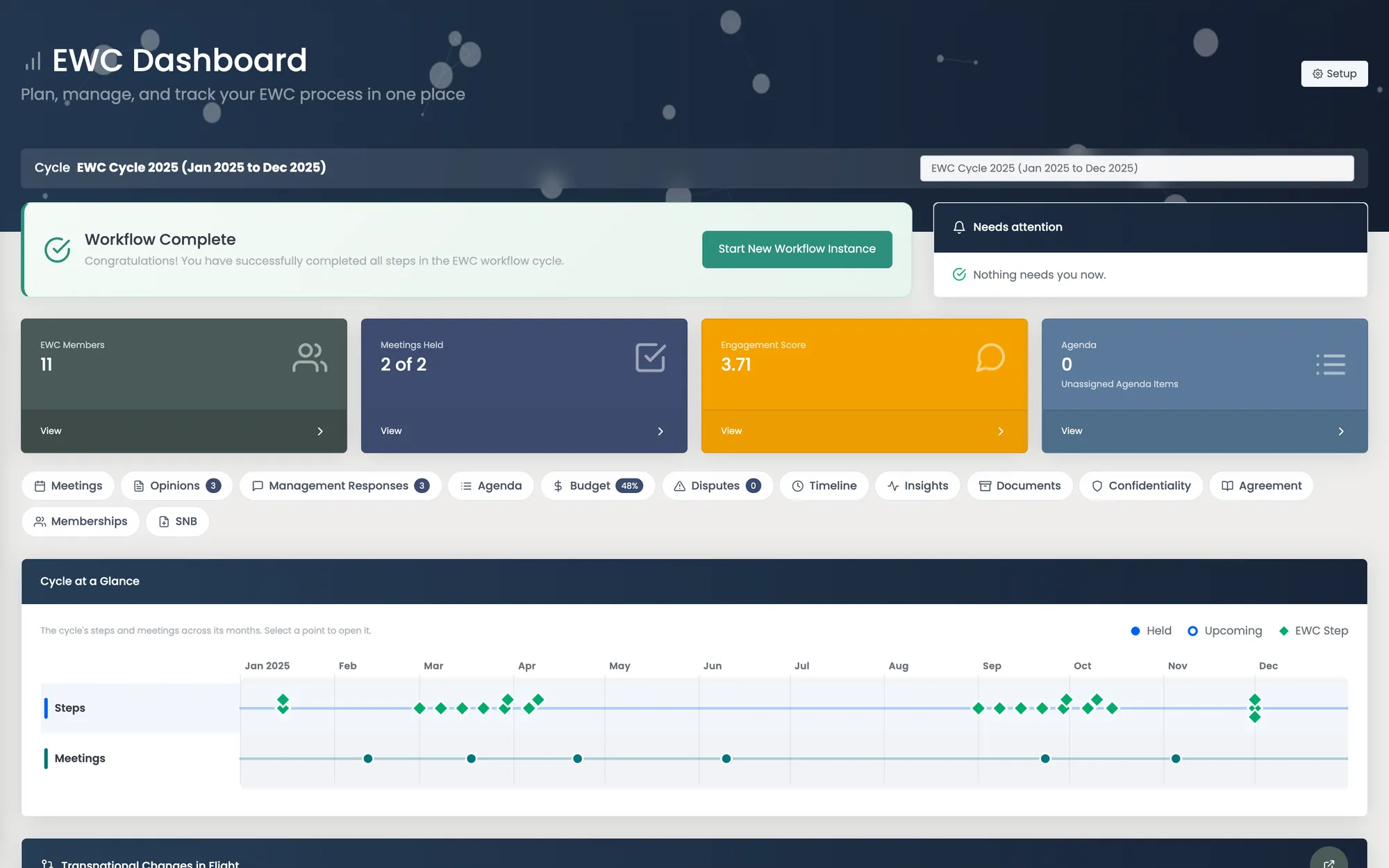
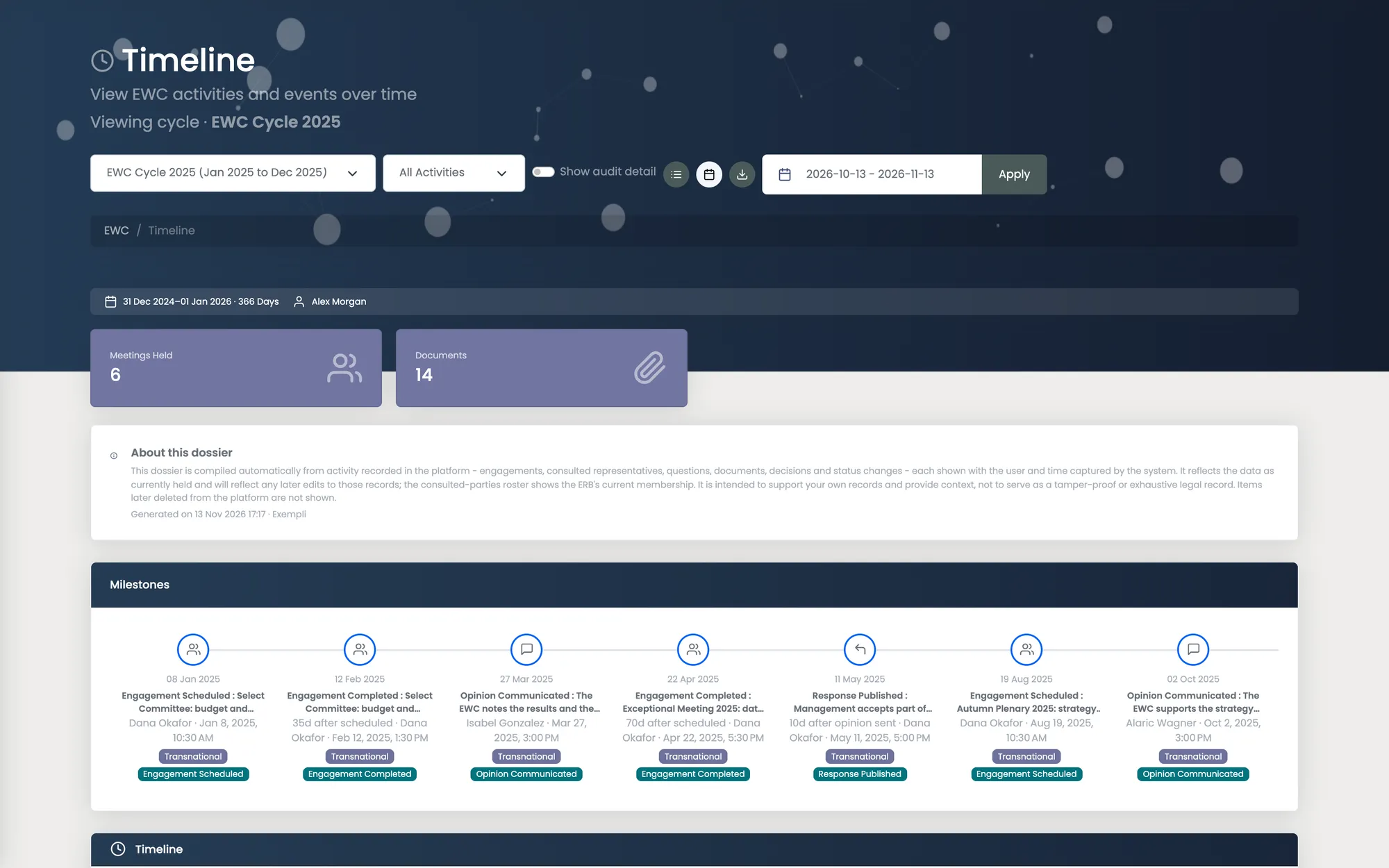
European Works Council software built around the obligations in your EWC agreement, not a generic template: meetings, information and consultation, opinions and responses, the budget, and an audit trail of every step.
- Draws on
- Your EWC agreement, and members by country
- Feeds
- The Landscape timeline and the EWC audit dossier
Guided setup
Four steps: record your agreement, set membership by country, configure the consultation workflow and start the year.
Deadline checks
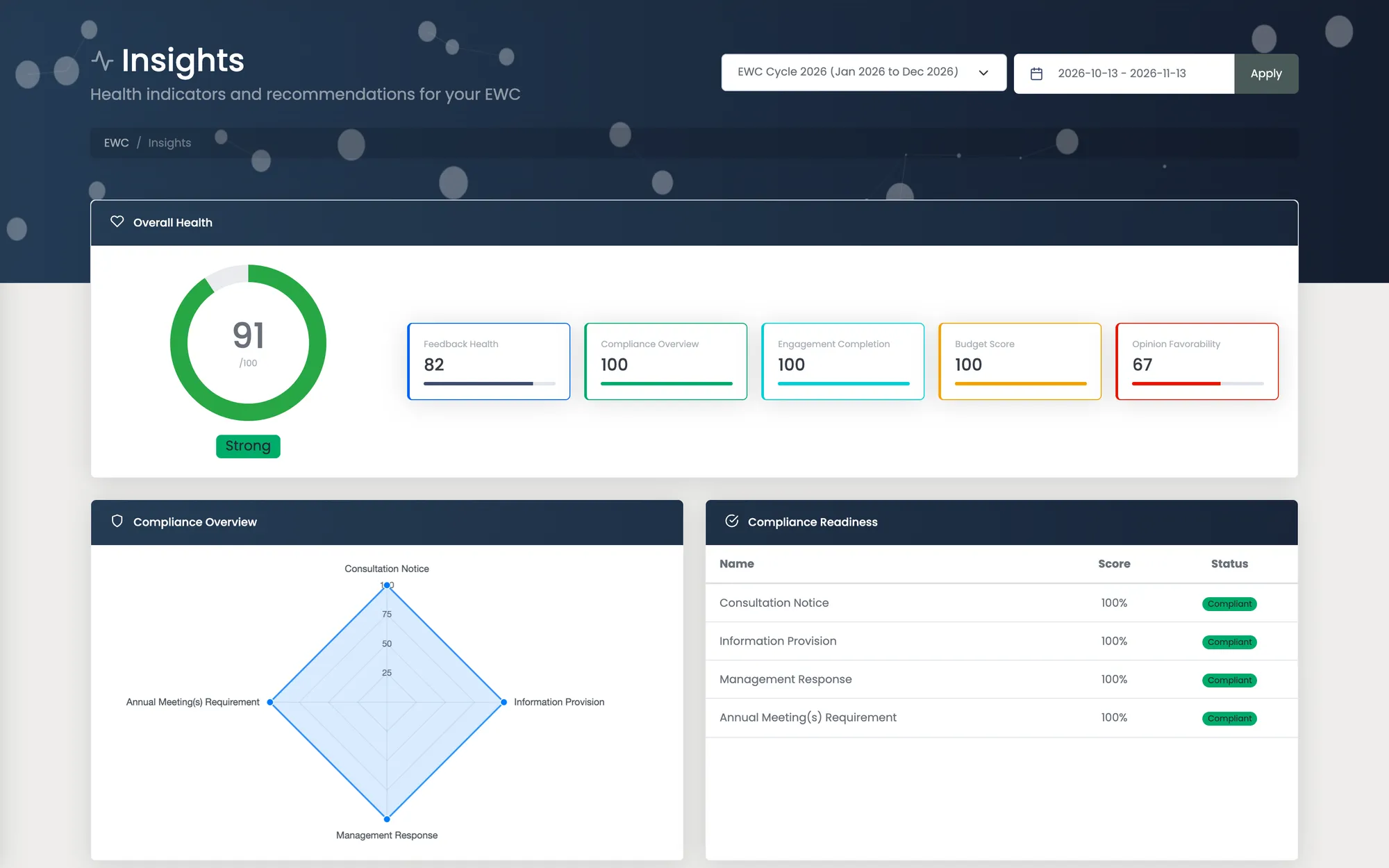
Notice, document sharing and response periods are checked automatically against the periods you set for your agreement, with a compliance view for the year.
A workflow built to your agreement
Editable workflow templates for information and consultation, with a visual diagram and step by step progress.
Opinions and responses
Track each EWC opinion and management’s response, with reminders as deadlines approach. GrAI summarises opinions and drafts the response for you to edit.
Special Negotiating Body
Proportional seat calculation by country, nomination tracking, and each country’s selection method and status on record.
Budget and costs
Set the EWC budget, log costs by category and see what remains, with each cost linked to its meeting where you choose.
Related: European Works Council software and the revised EWC Directive.
Change Advisory Gateway
Hear about change while there is still time to shape it.
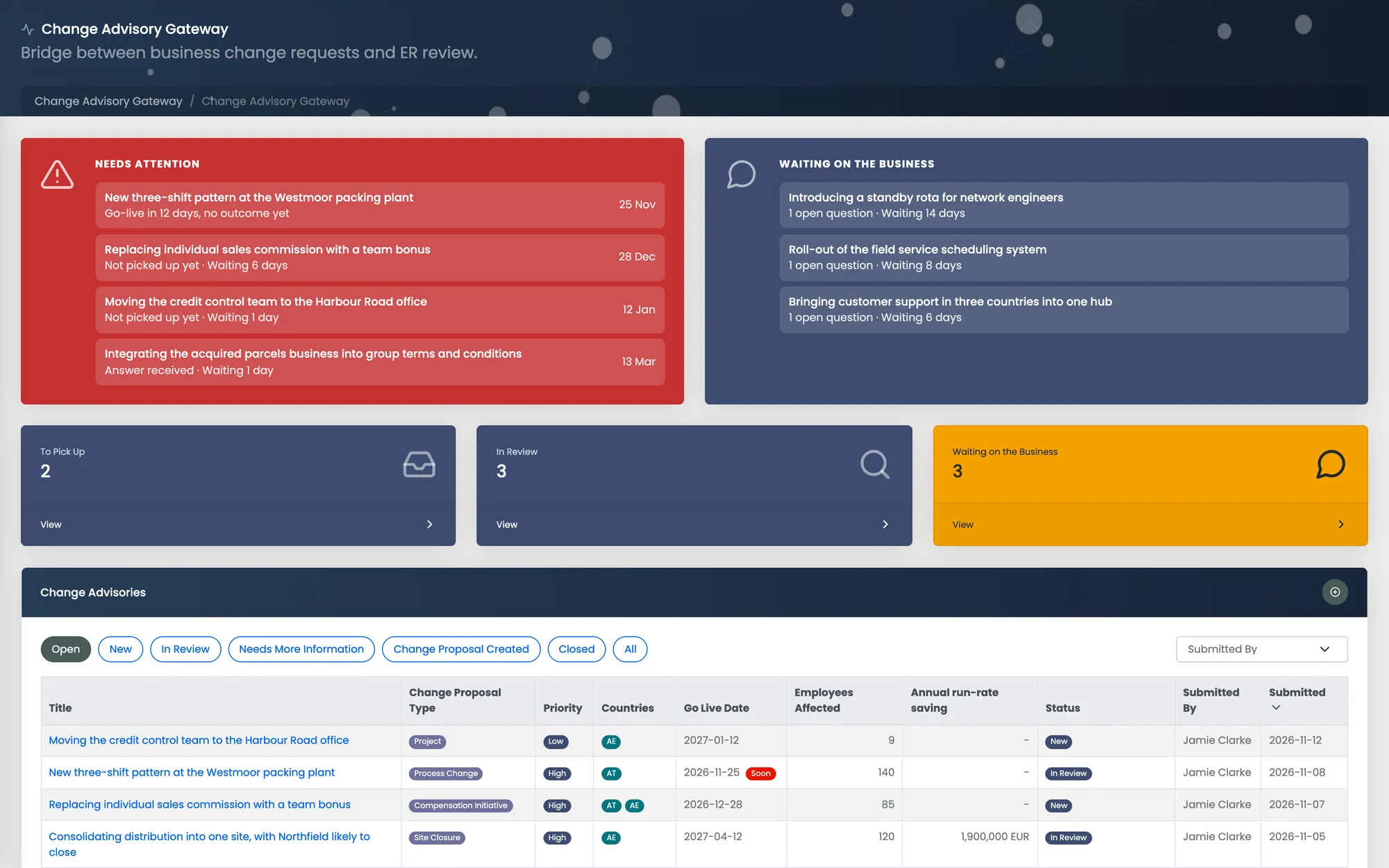
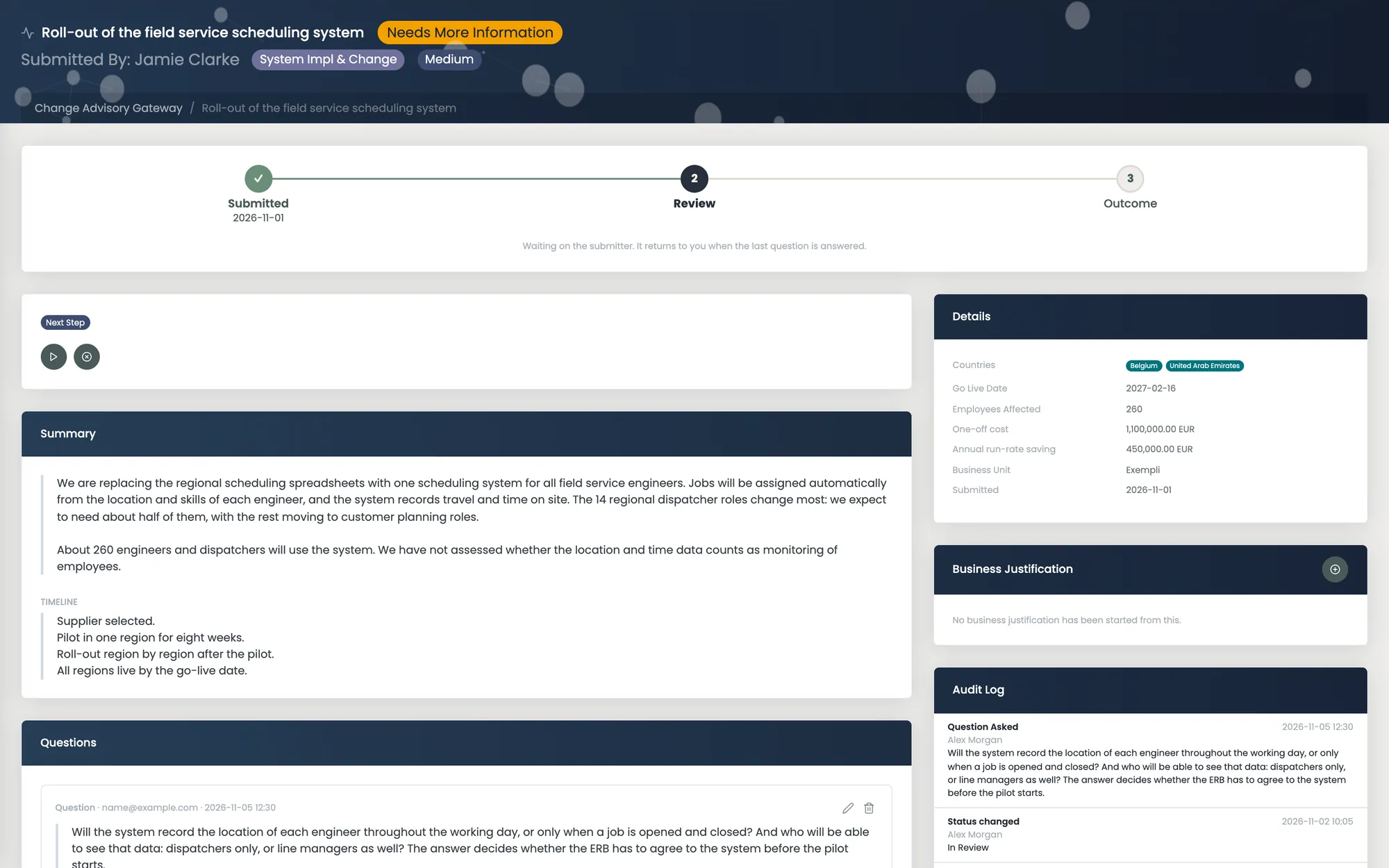
The business tells employee relations what it is planning in one short form. ER reviews it and asks what it needs to know, and the advisory ends in one of two outcomes: it becomes a Change Proposal with everything carried over, or it is closed with a note that says why none is needed.
- Feeds
- Change Proposals and Business Justification, with details and documents carried over
- Shares
- The change types and country access rules of Change Proposals
A short form for the business
Title, summary, countries, go-live date, people affected and a cost estimate. The form shows how long advisories of that type have typically taken to reach an outcome.
A desk that ranks the work
ER sees what nobody has picked up and how long it has waited, answers that have arrived, and go-live dates that are getting close.
Questions as a conversation
Asking a question sends it to the submitter by email and marks the advisory as waiting on the business. The answer brings it straight back.
Becomes a Change Proposal
One action creates the proposal from the advisory’s details, estimate and documents, and links the two. Or link a proposal that already exists.
Discreet by design
Business users see only their own advisories, ER sees its own units and countries, and nothing is posted to a shared Slack or Teams channel, because a title can describe a change that is not yet announced.
Audit log and insights
Who did what and when, in words. Plus average days to an outcome and the share of advisories that became proposals.
Related: workforce change consultation.
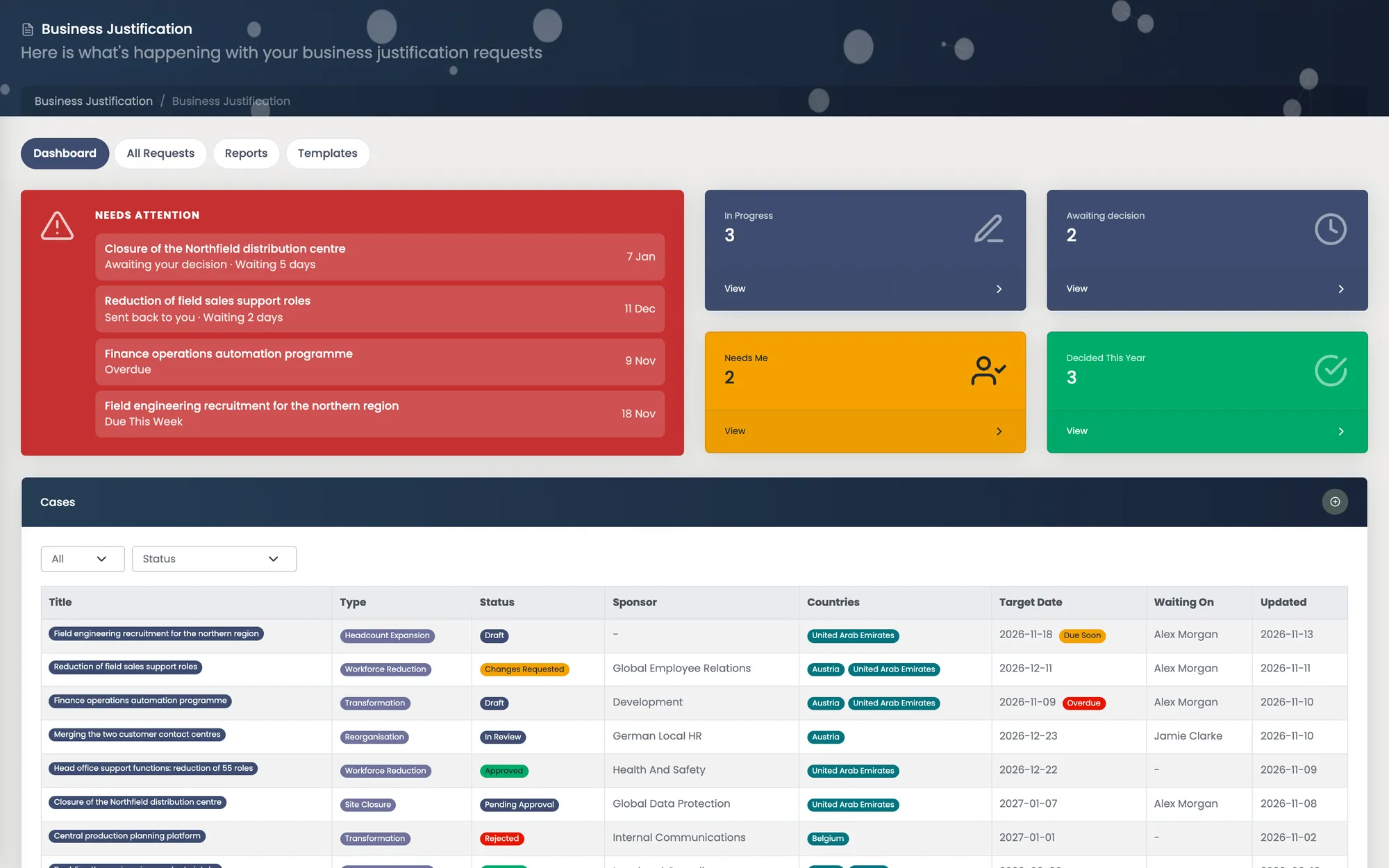
Business Justification
The case for change, written once and decided on the record.
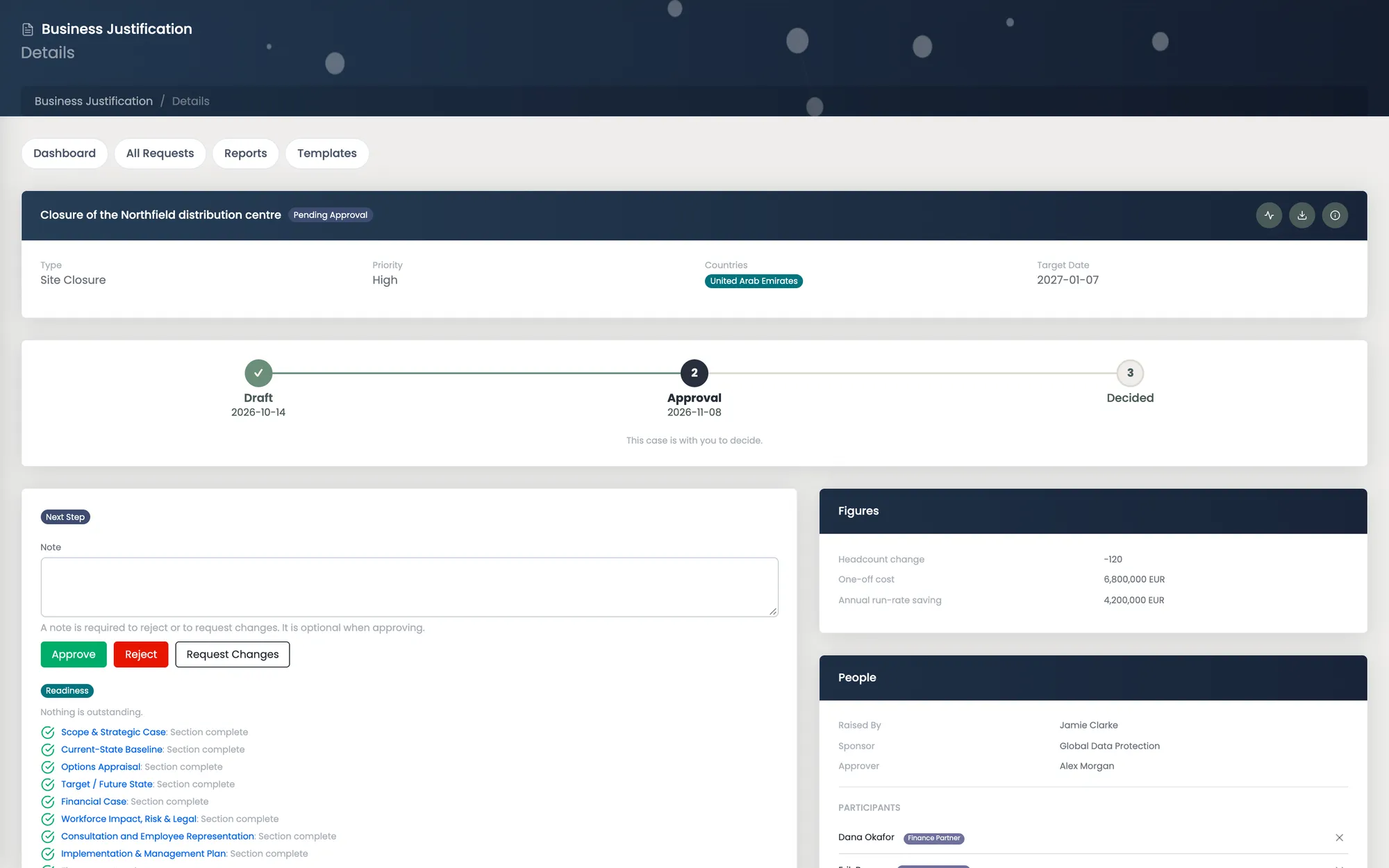
Before a reorganisation, site closure or workforce reduction goes any further, its business case is set out in standard sections, checked for readiness and decided by a named approver. An approved case becomes a Change Proposal or a Reduction In Force initiative without retyping a word.
- Draws on
- Advisories from the Change Advisory Gateway, and headcount from Graylark People or a connected HR system
- Feeds
- Change Proposals and Reduction In Force
A standard case
Seven sections from strategic case to implementation plan, including the options considered and doing nothing. Collective changes get an eighth, on consultation and employee representation.
Draft with GrAI
GrAI writes a first draft of a section from the title, type, countries, figures and what the other sections say. Nothing is saved until you have read and saved it.
Locked once submitted
What the approver reads cannot change under them. Sections, figures and sponsor lock on submission, and every earlier revision is kept.
A named approver
The author names who decides, and nobody approves their own case. Rejecting or sending back needs a note, and the decision record of who, when and why is printed in the PDF.
Hand-off without retyping
An approved case creates a Change Proposal or a Reduction In Force initiative with its title, type, countries, sponsor and figures.
Figures and reports
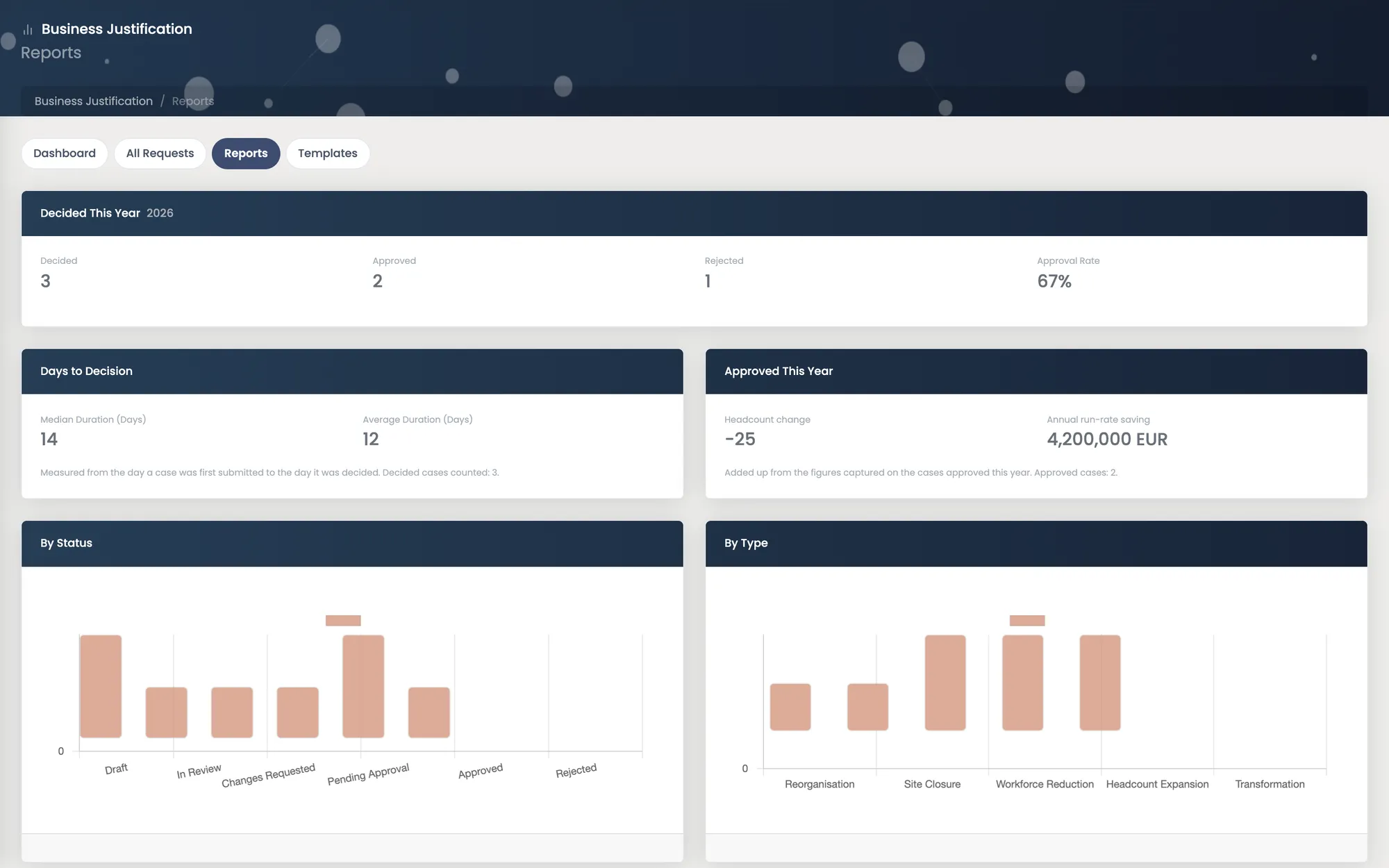
Headcount change, one-off cost and annual saving on every case, with approval rate, days to decision and the totals approved this year.
Related: workforce change consultation and Data Safe AI.
Reduction In Force
Plan a workforce reduction with thresholds, protected employees and costs in view.
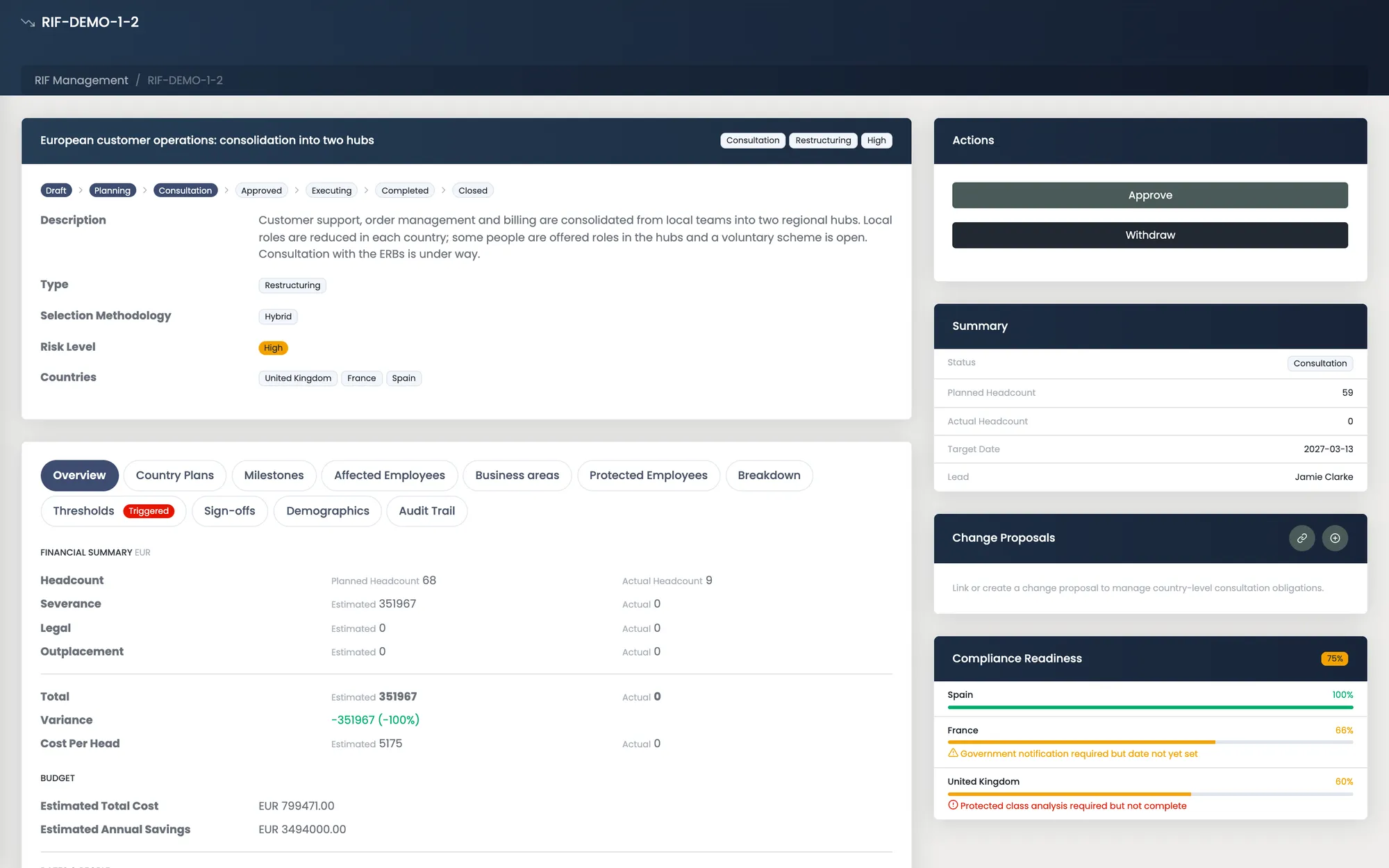
A reduction in force, redundancy programme or restructuring, planned country by country: who is affected, what it costs, which collective redundancy thresholds it crosses and who is protected. Protection is read live from the ERB seats and elections you already hold in Graylark, and approval waits for every sign-off.
- Draws on
- Business Justification, ERB seats and union roles in the Landscape, candidacies in Graylark Elect, Graylark People
- Linked to
- The Change Proposal that carries the consultation
Country plans and milestones
One plan per country with its costs in local currency and its consultation and notification dates. Each country’s HR sees only its own people.
The affected population
Add people by hand, by upload or from Graylark People. Group them by business area and see headcount, pay and severance by area, manager, country, legal entity or site.
Collective redundancy thresholds
Checked live with the same rules as Change Proposals, counting the unit’s other live initiatives too, so two small programmes cannot quietly add up to a collective one.
Protected employees
Council seats, union roles and election candidacies are read from the Landscape and Graylark Elect, with the dates protection runs to.
Severance estimates
Severance rules for nine countries, each with its legal basis and sources: the statutory formula where the law sets one, and a plain statement where it does not. Estimates rest on the data on record and are not legal advice.
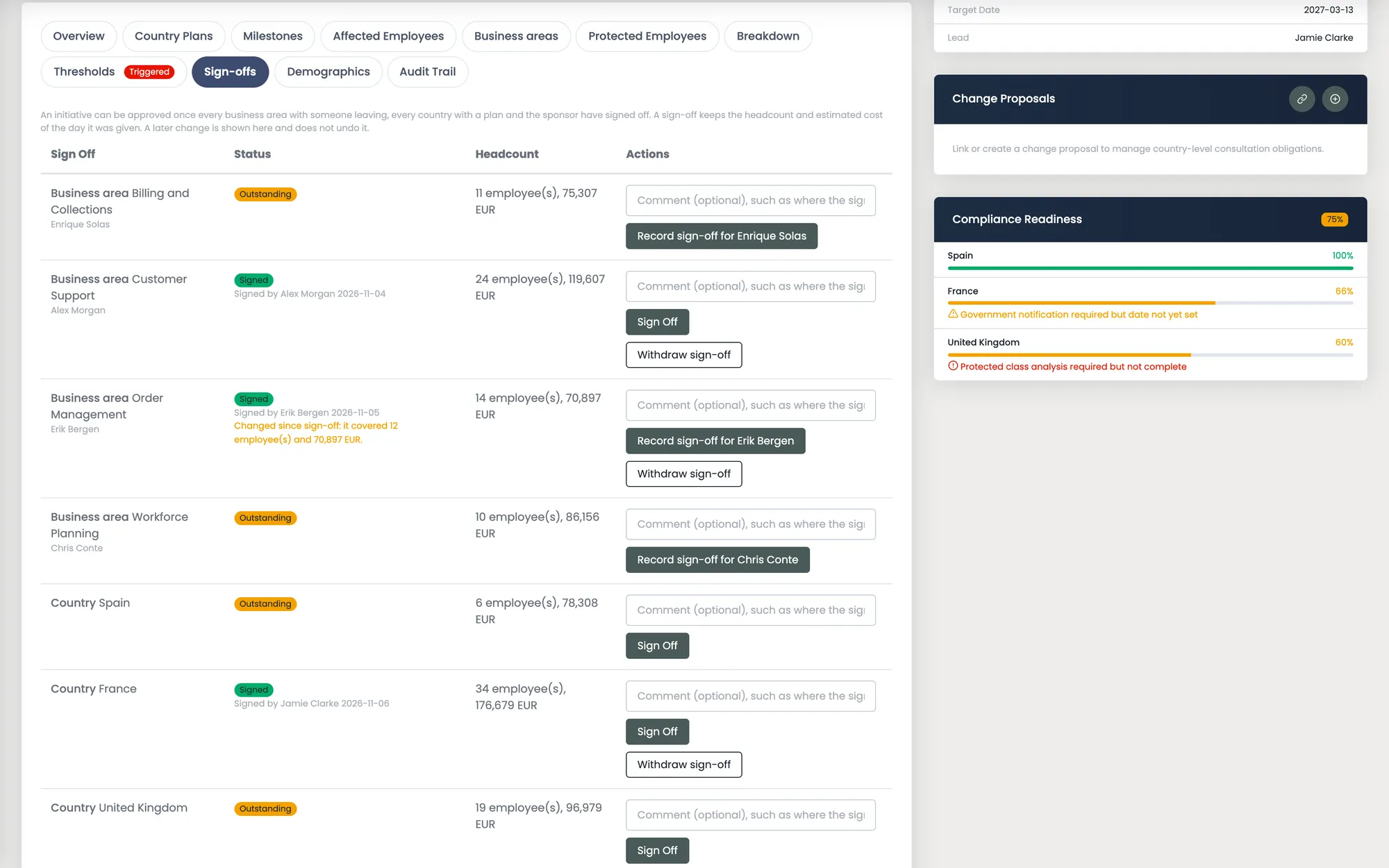
Sign-offs before approval
Each business area, each country and the sponsor sign off first. Approval is a separate permission and never the person who created the initiative.
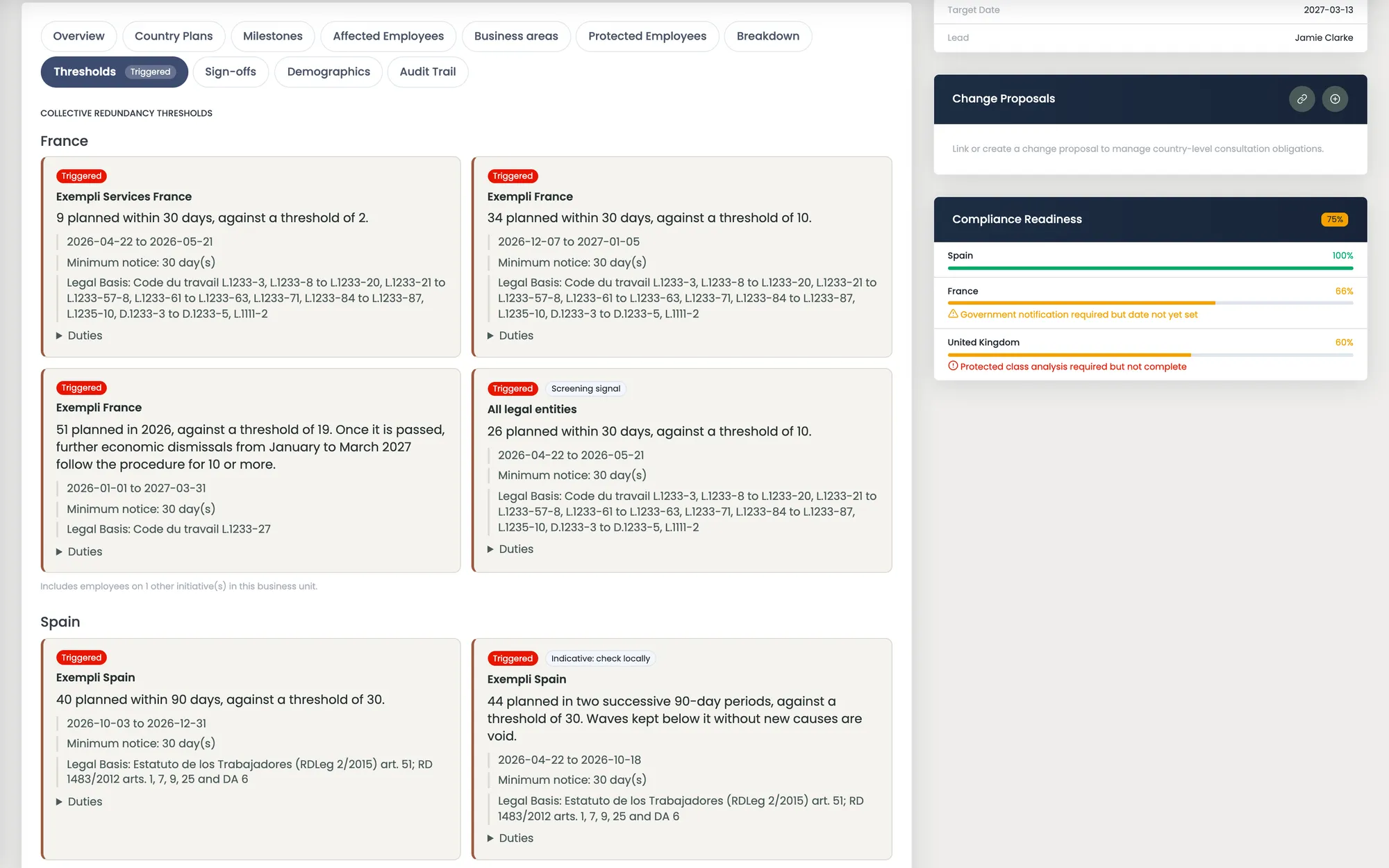
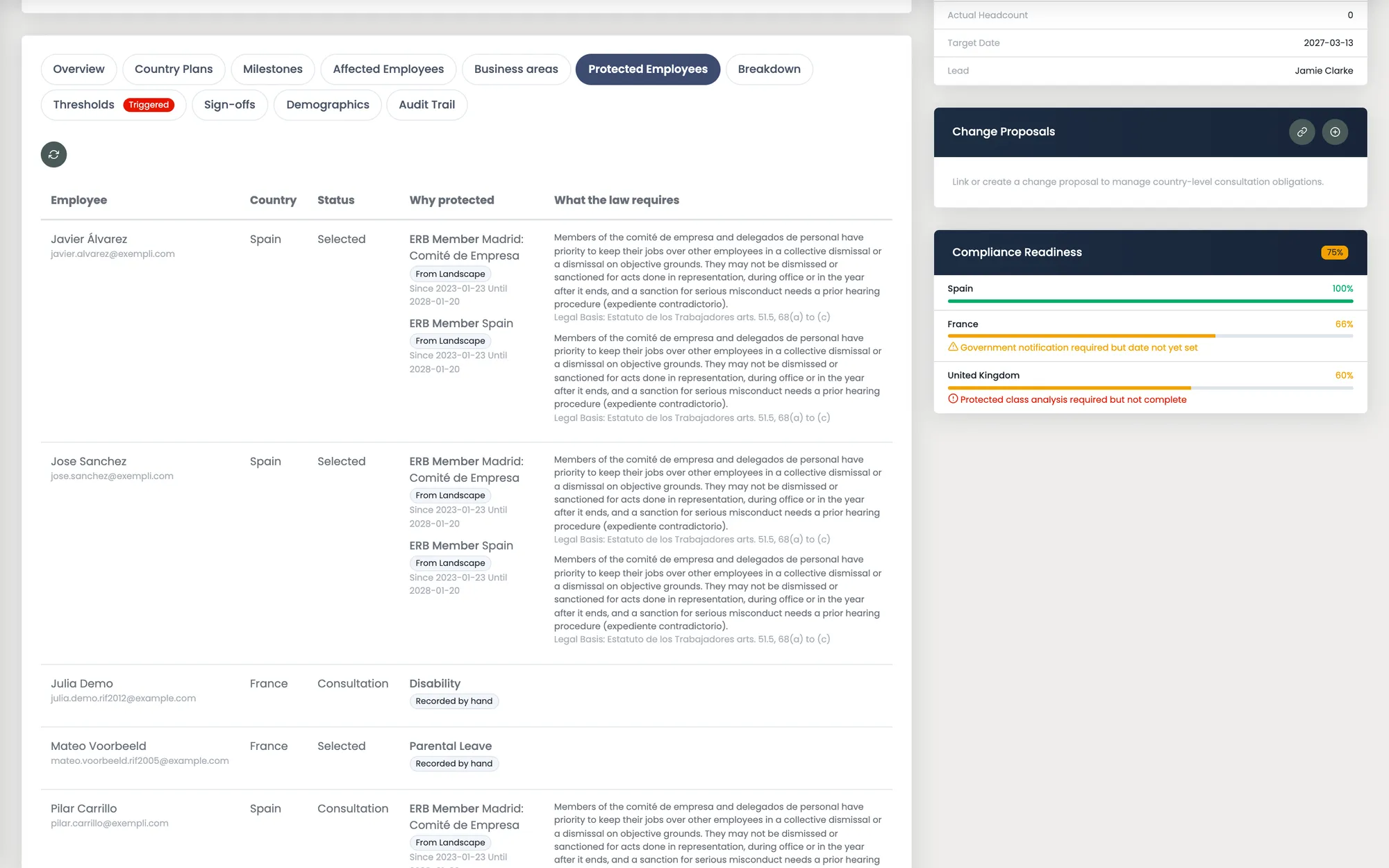
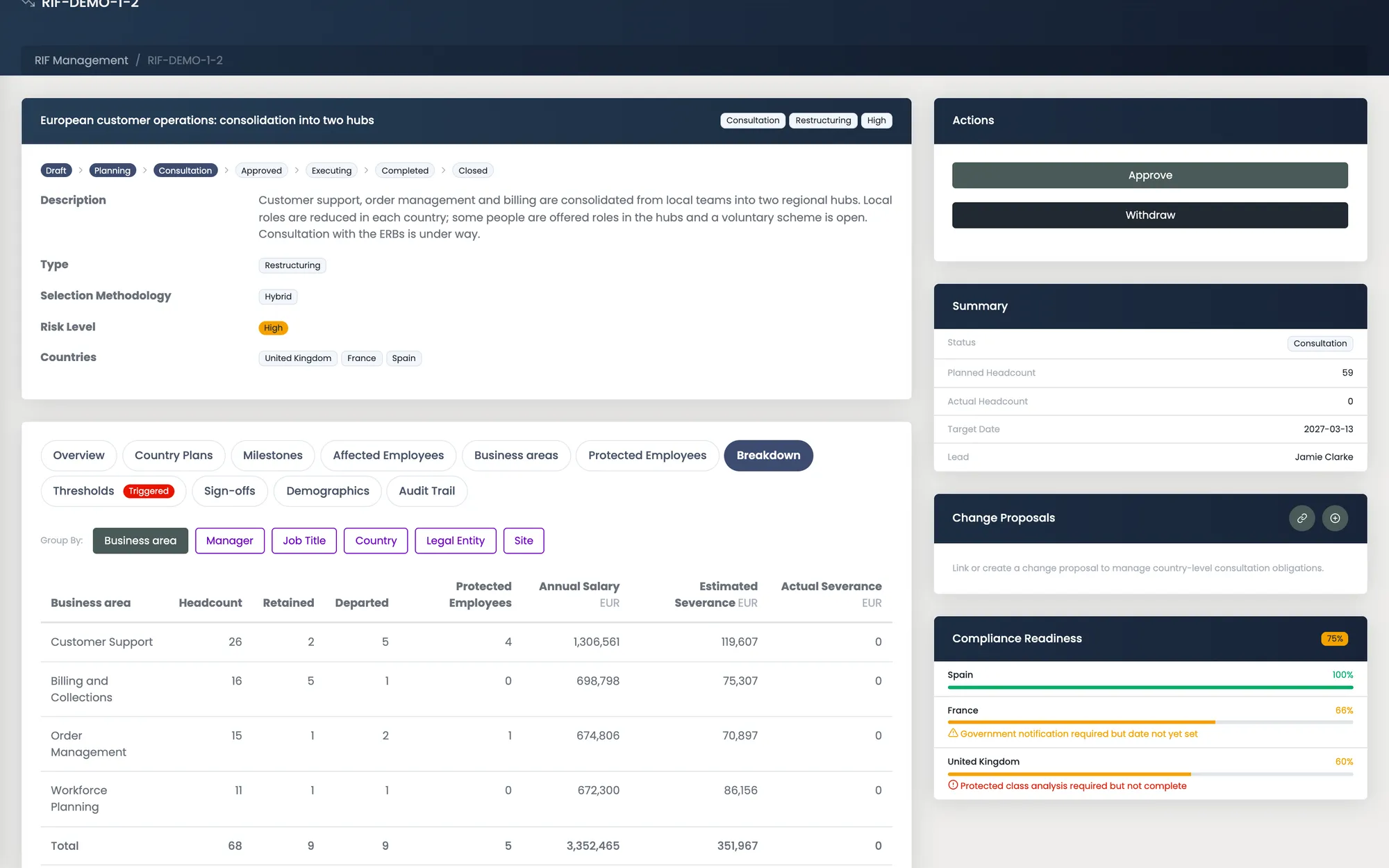
Severance rules are held for Austria, France, Germany, Ireland, the Netherlands, Poland, Spain, the United Kingdom and the United States. Summaries of what protection requires are held for Austria, France, Germany, Spain and the United Kingdom.
Related: cross-border restructuring consultation and the consultation readiness check.
Graylark Elect
ERB elections that update your records when the count is done.
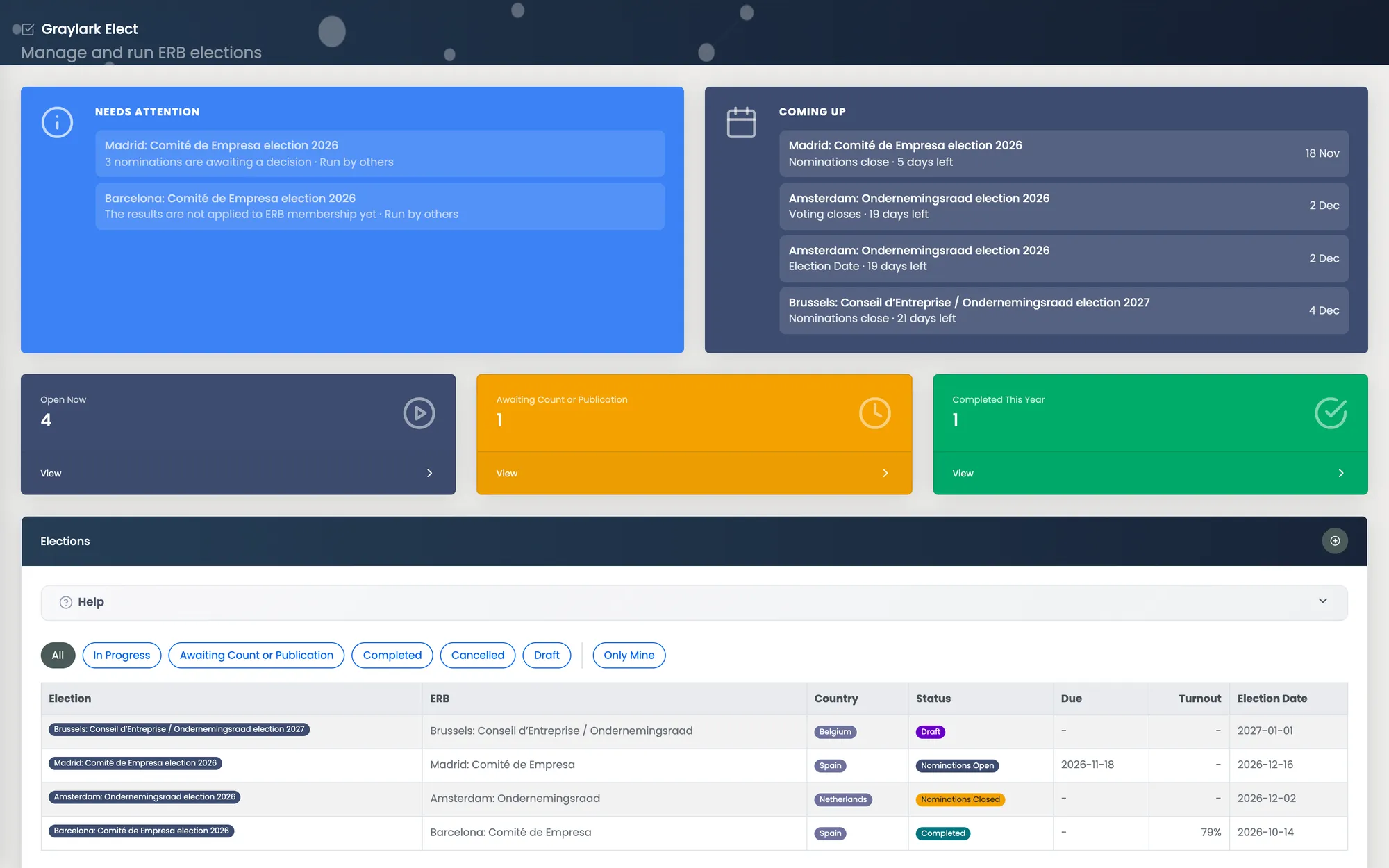
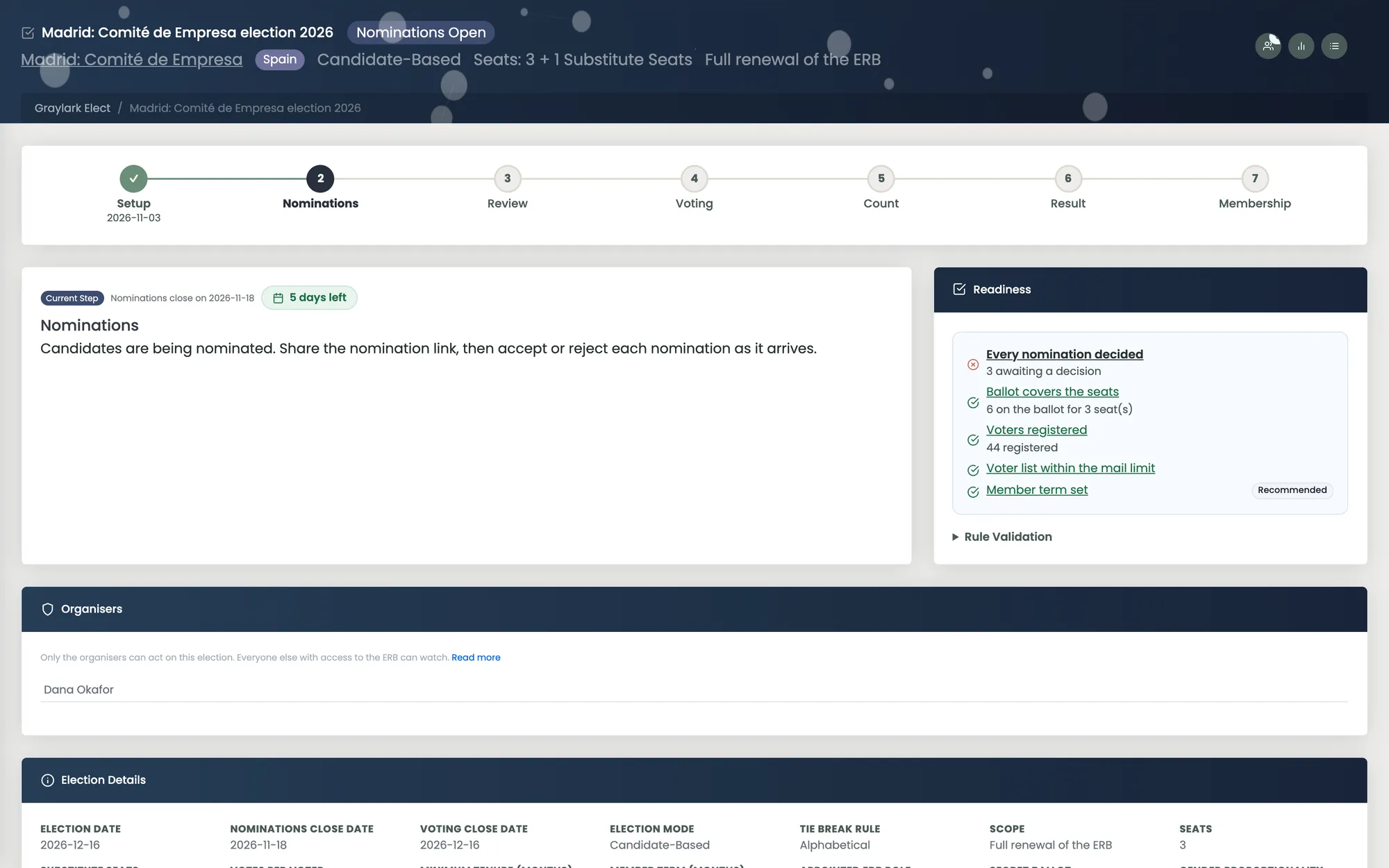
Most election and voting software stops at the result. Graylark Elect runs the election for the works council or other ERB you already hold in Graylark, with its seats and rules, and applies the result to its membership. Your records are current the day the election closes.
- Draws on
- ERBs and seats in the Landscape, the voter roll in Graylark People
- Feeds
- ERB membership in the Landscape, and candidates’ protected status in Reduction In Force
Applied to the ERB
Apply the result and the body’s membership is updated in the Landscape. No re-keying, and every module that reads the ERB sees the new members.
Secret by design
Each voter receives a unique, secure invitation. A ballot holds no link to the person who cast it, so how someone voted cannot be looked up.
Nominations
Add candidates yourself or open self-nomination. Candidates are told when they are accepted or rejected.
Seats and allocation
Proportional allocation by the d’Hondt method where your rules call for it, substitutes, and gender balance reported against your targets.
Voter roll and reminders
Build the voter roll from Graylark People, remind those who have not voted, and purge voter data when the election is over.
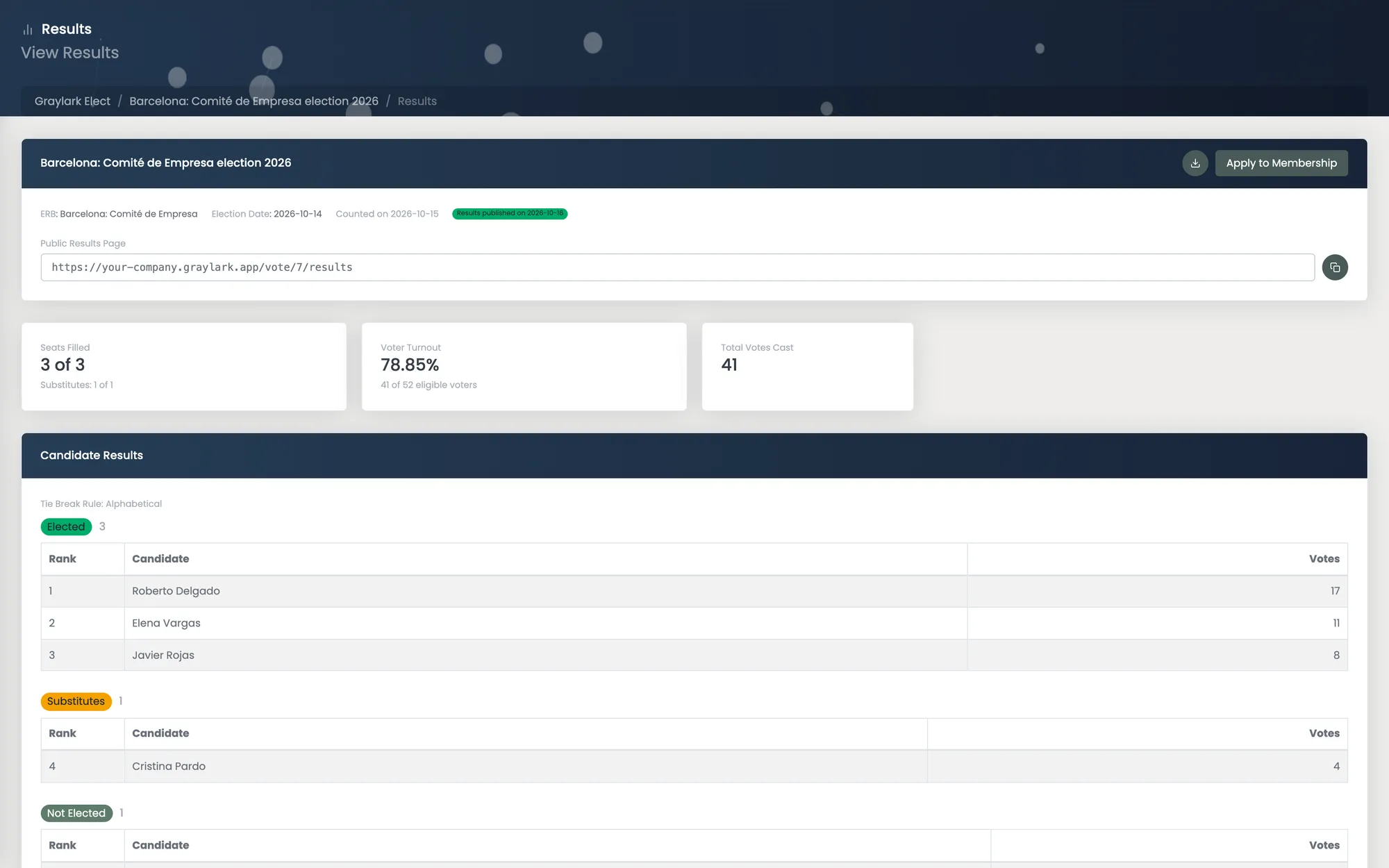
Results and audit
Turnout, seats and vote share as the election closes, with an audit trail of how the election was run and exports for the record.
For ERBs whose rules allow electronic voting. Not for statutory Betriebsrat elections in Germany or Austria, where the law does not provide for online voting; consultative ballots and EWC work are fine in both.
Related: works council management.
Conflict of Interest
A conflict of interest register that knows who has not declared.
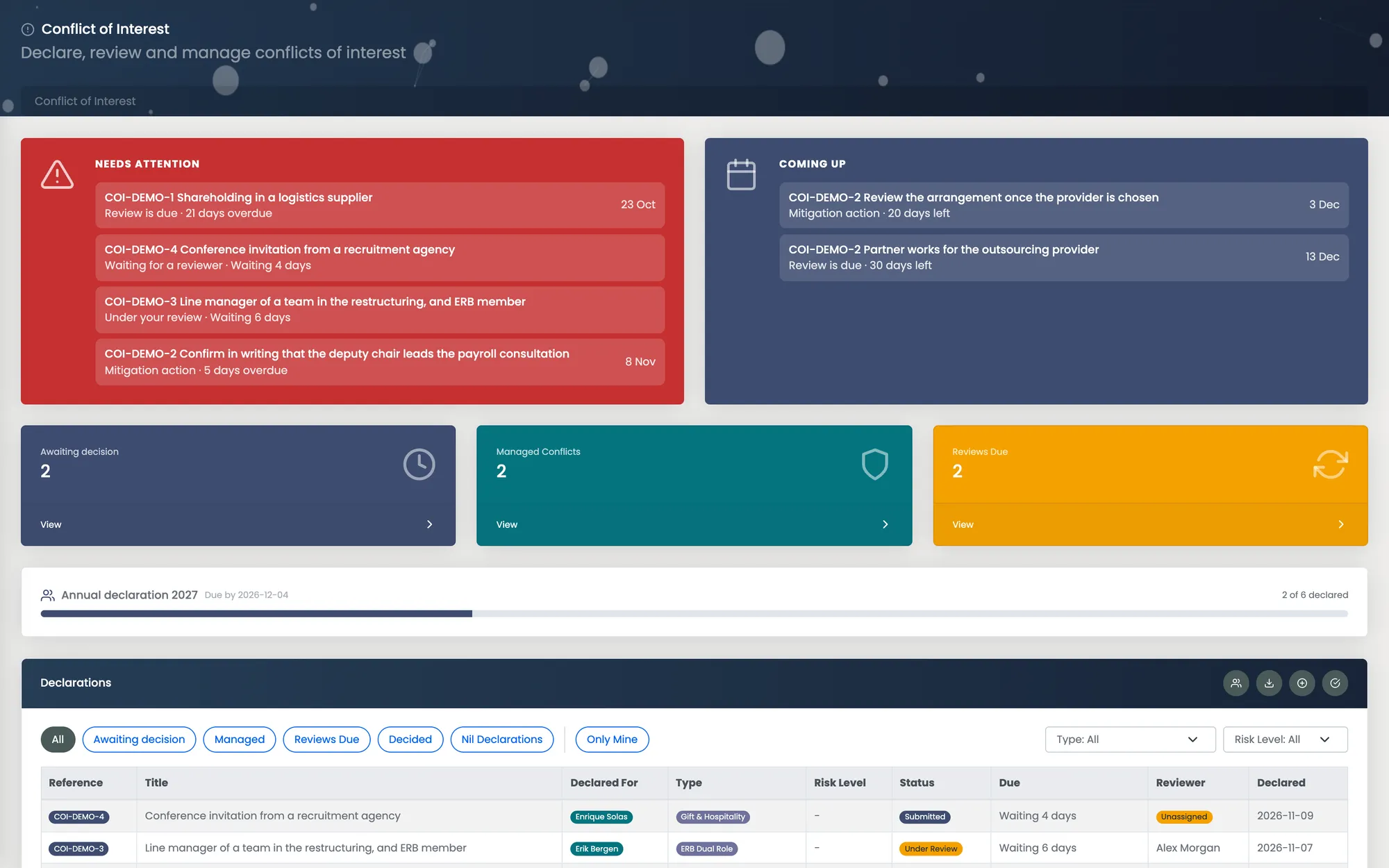
Declarations, reviews and managed conflicts in one register, with the audit trail an auditor asks for. Declaration rounds work from your actual users, so new joiners are asked automatically, and nobody can review their own declaration.
- Draws on
- Your users and business units, and the person’s record in Graylark People
- Feeds
- A linked incident in the Case Portal when a conflict is escalated
Declare, or record for someone
People declare their own conflicts. A reviewer can record one about someone else, who is told, can see it and can never review it.
Declaration rounds
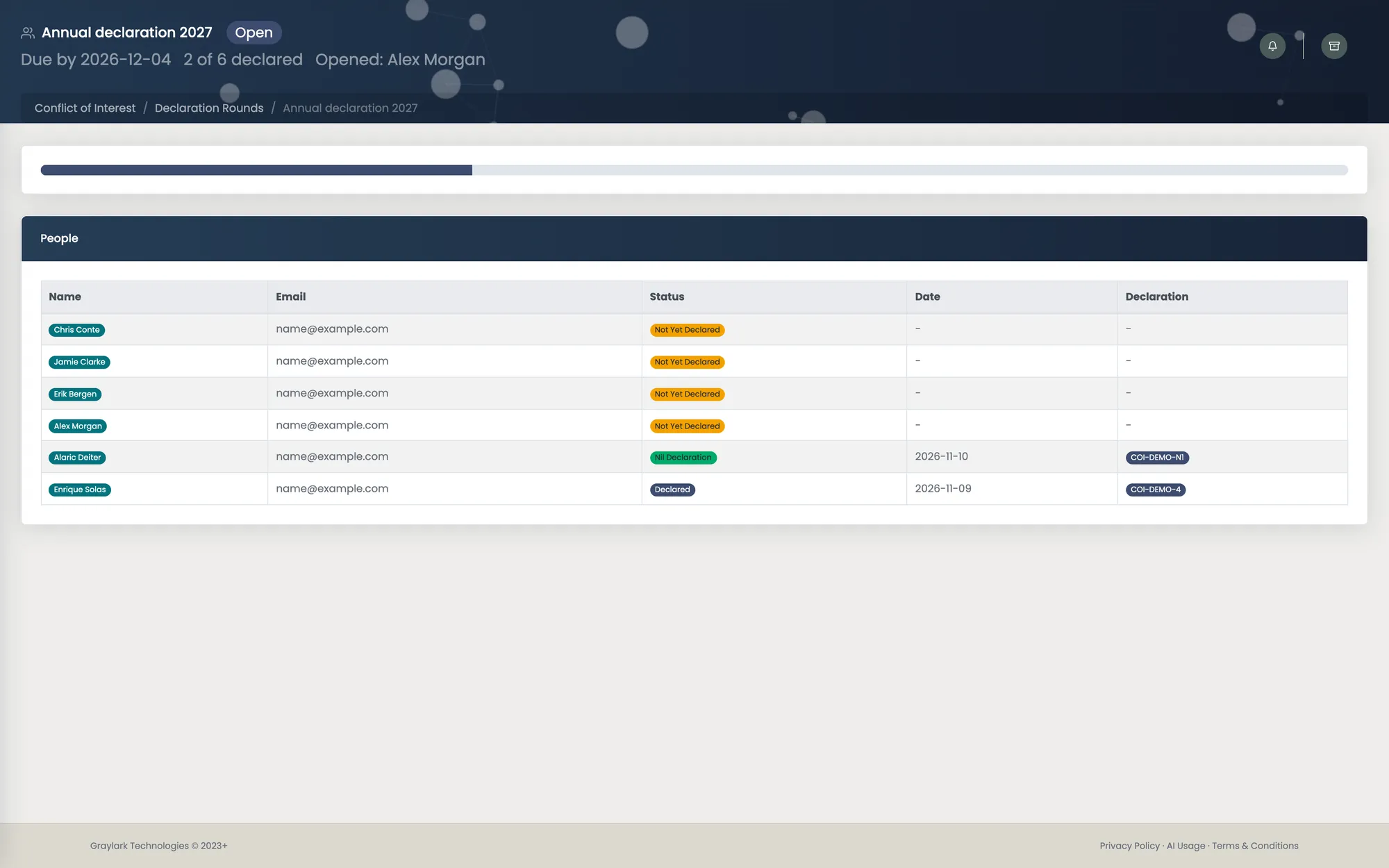
Ask everyone in a business unit to declare, or confirm they have nothing to declare, by a due date. See who has not answered and remind them in one click.
Nil declarations
A formal statement that there is nothing to declare, recorded once per round or per year and kept apart from the conflicts.
Review and decide
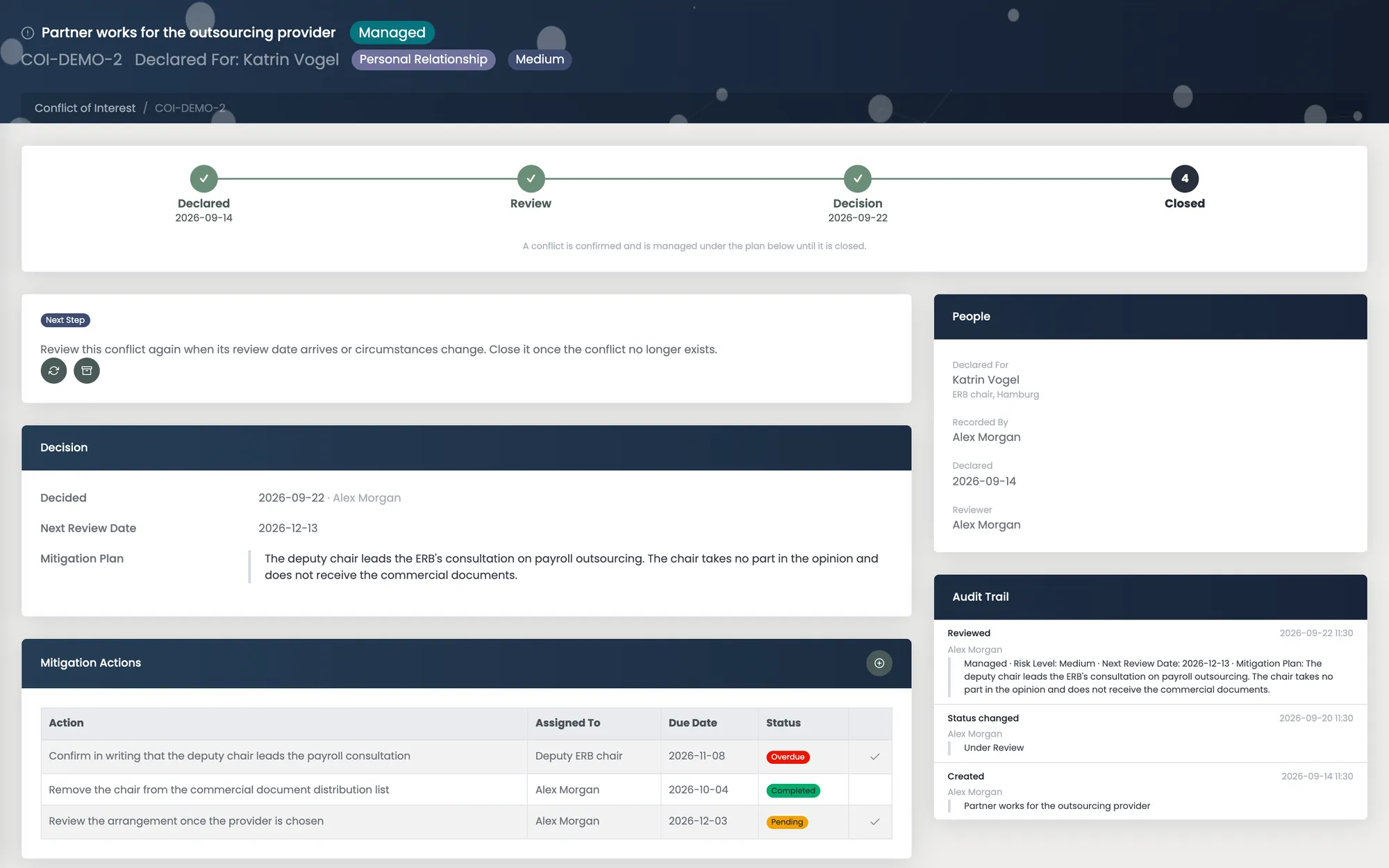
Three decisions: a conflict to manage, with a risk level, review date and mitigation plan; no conflict, with the reason; or escalation to an investigation in Graylark’s Case Portal where you use it.
Mitigation and review dates
Concrete actions with an owner and a due date, flagged when overdue. Reviewers are reminded before each review date and on the day.
Personal data, treated as such
Only the person concerned and the reviewers for their unit or country can open a declaration. Nothing goes to Teams or Slack, every action is audited, and the register exports to CSV.
Graylark Collaborate
The work around consultation, kept beside the records it concerns.
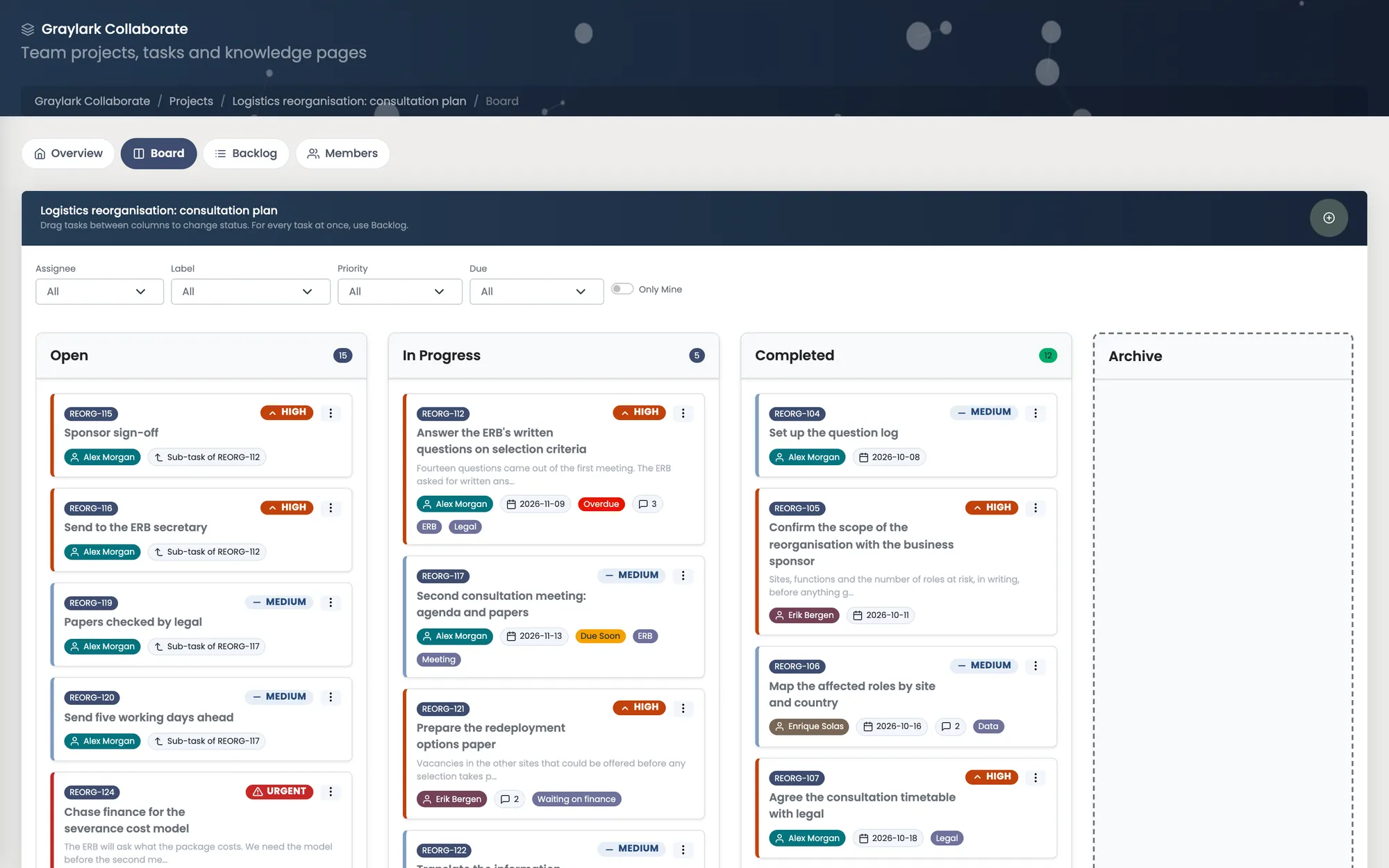
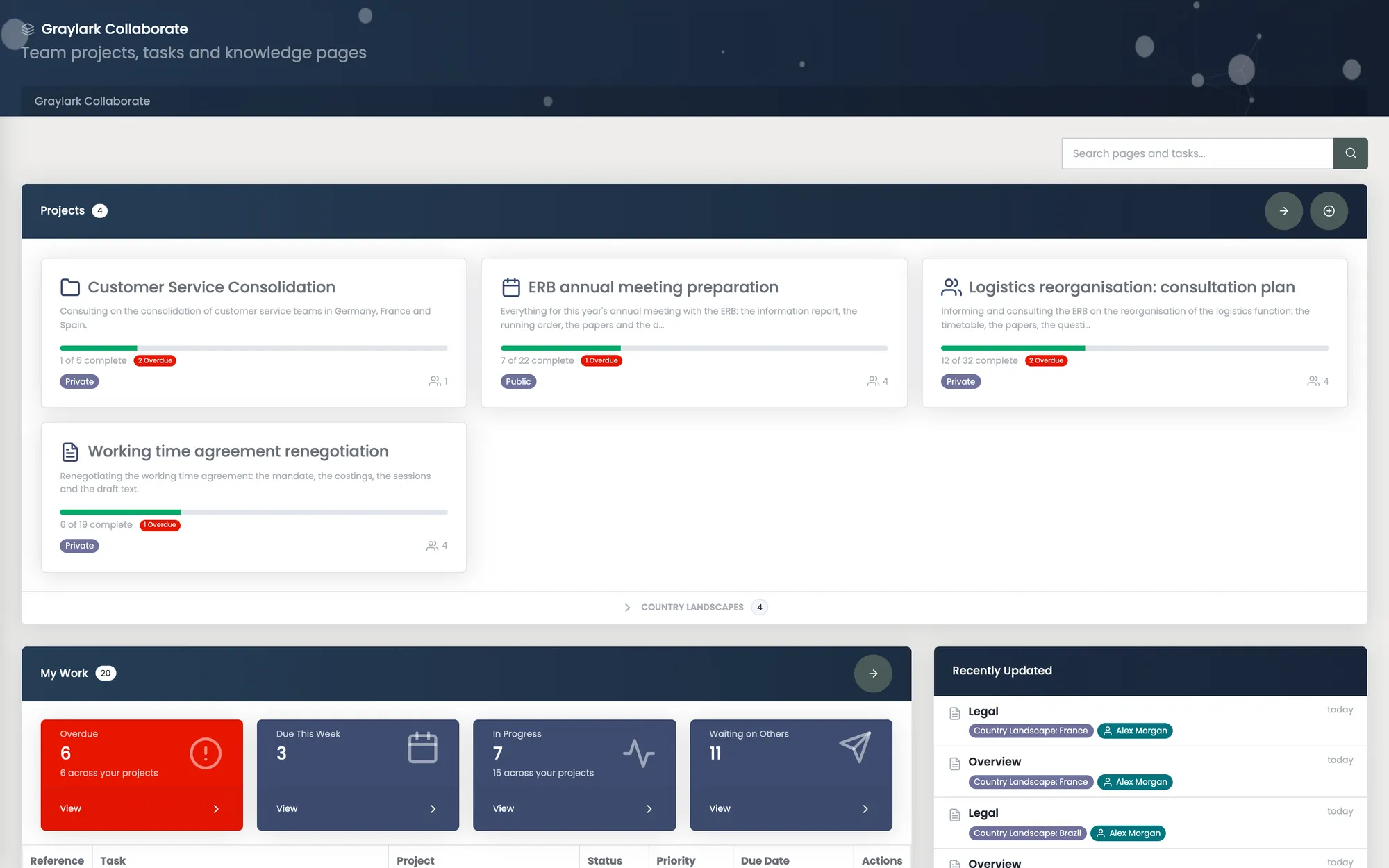
A workspace for the projects that surround consultation: one for each programme, ERB or annual review, with a task board, a backlog and pages for guides, meeting notes and decisions. Tasks link to the Graylark records they are about, so the plan and the record stay together.
Projects
One project per programme, body or review, public to the team or private to its members, with owners, members and viewers.
Task board
Drag tasks from open to in progress to completed. The backlog holds everything, with priorities and subtasks.
Knowledge pages
Guides, meeting notes and decisions in a page tree, with templates, version history and compare.
Comments and mentions
Discuss a task or a page where it lives, mention a colleague, and follow what matters to you.
My tasks and reminders
Everything assigned to you across every project in one list, with reminders as due dates approach.
Linked and searchable
Link a task to the record it concerns, search pages and tasks across projects, and export tasks to CSV.
Graylark Academy
We teach the craft of employee relations, not only the software.
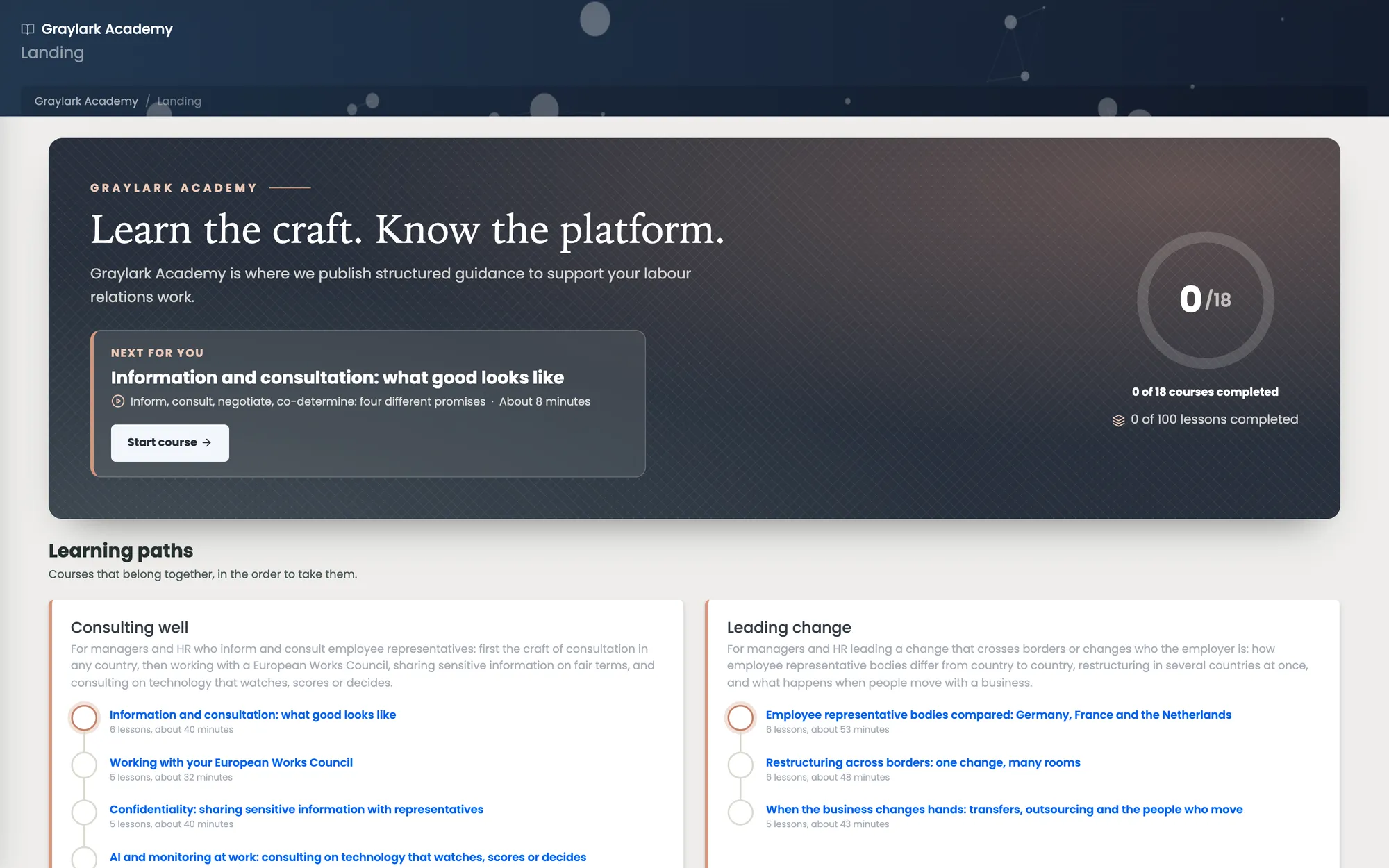
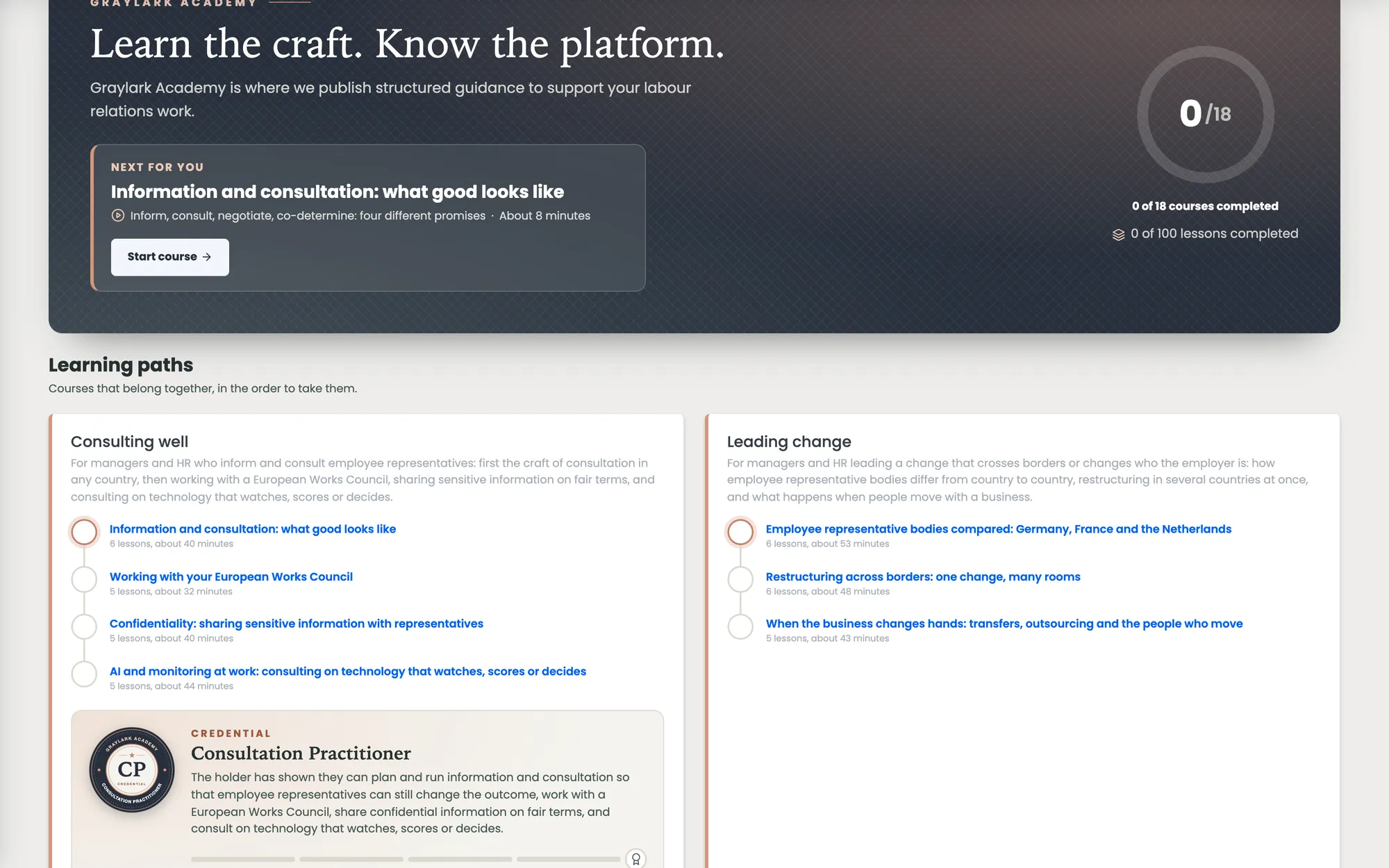
Graylark Academy is part of the platform for every organisation, with nothing to switch on. It holds courses on consulting well, leading change across borders and working with employee representatives, alongside courses on Graylark itself and a reference library covering 28 countries.
Courses on the work
Information and consultation, working with your European Works Council, restructuring across borders, negotiating, collective agreements, confidentiality, trade unions, transfers, grievances, disputes, and AI and monitoring at work.
Courses on the platform
First steps for each role, and courses on Landscape, Change Proposals and Collaborate for organisations that use them, with pictures of the real screens to explore.
Learn by deciding
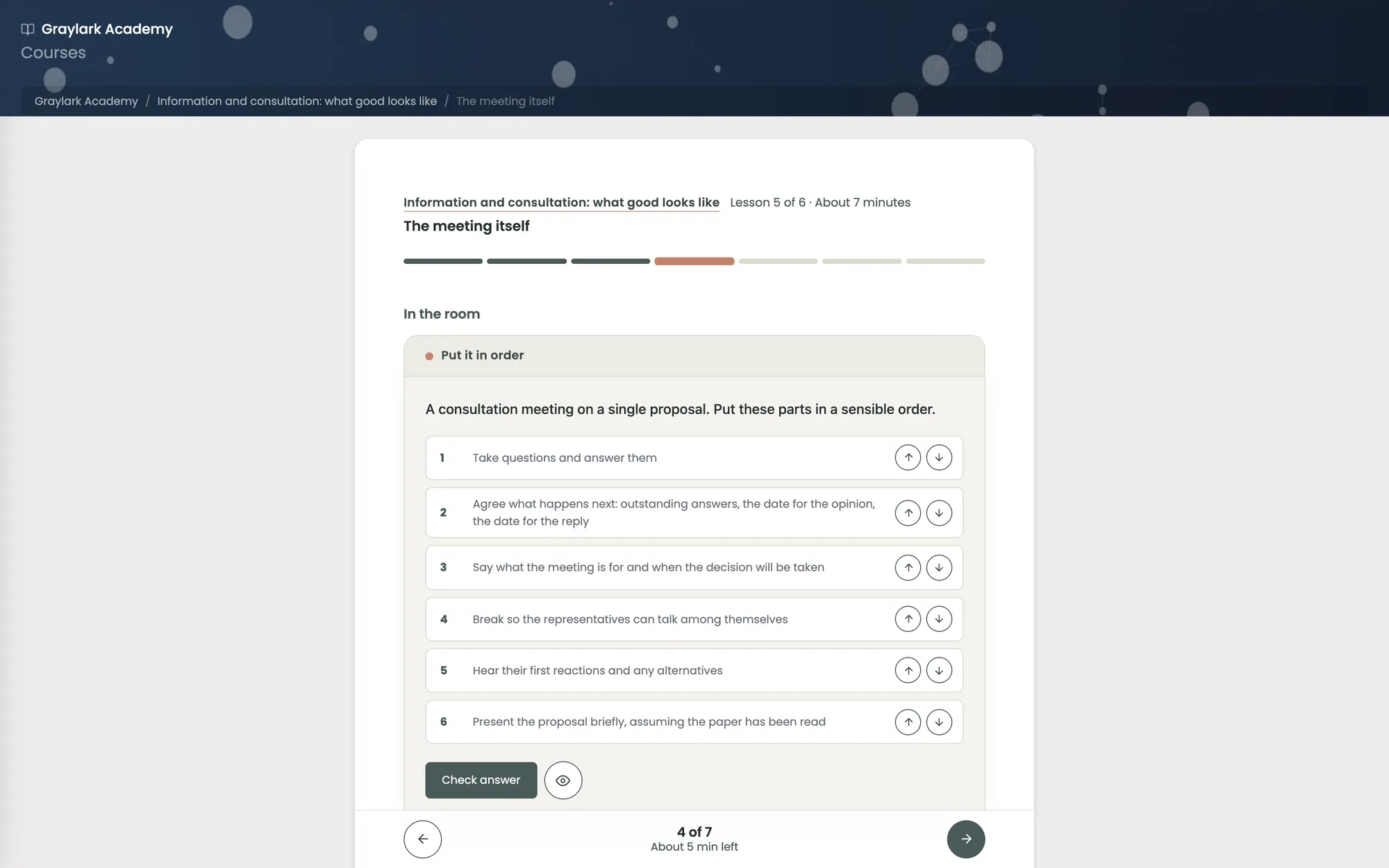
Lessons are worked through, not only read: scenarios that play out by your choices, plans against a deadline, and questions that explain every answer.
Certificates and a credential
Assessments draw fresh questions each sitting, and what you missed comes back for review days later. The Consultation Practitioner credential, earned by a capstone paper, can be added to LinkedIn.
Both sides of the table
Management and HR have their courses, employee representatives have theirs, and each sees only their own.
Private to the learner
Progress and scores are shown only to the person who earned them. No screen lists who passed what, which matters wherever testing employees is a matter for co-determination.
Courses are in English. Certificates and credentials record learning from an online, unsupervised assessment; they are not professional qualifications.
Questions about the modules.
Which modules does Graylark include?
Landscape, Change Proposals and the EWC Portal are the core. Around them sit the Change Advisory Gateway, Business Justification, Reduction In Force, Graylark Elect, Conflict of Interest and Graylark Collaborate. Graylark Academy is included for every organisation.
What is an ERB?
An employee representative body: any body that represents employees to their employer. That includes works councils such as a German Betriebsrat, a French CSE or a Dutch ondernemingsraad, trade union bodies, and a European Works Council. Graylark uses ERB because the right word differs in every country.
How is Graylark Elect different from other election or voting software?
A voting tool runs a ballot. Graylark Elect runs the ballot for a body Graylark already holds, with its seats and its members, and applies the result to that body’s membership. The Landscape is correct the day the election closes, and candidates’ protected status is visible when a reduction in force is planned.
Does Graylark help with collective redundancy consultation?
Yes. Change Proposals and Reduction In Force check planned reductions against collective redundancy thresholds by jurisdiction, show which ERBs must be consulted, and track each country’s consultation and notification dates. It informs your decisions and does not replace legal advice.
Do I need every module?
No. Modules are switched on separately, so you start with what you need. Most of them draw on the Landscape, which is why it usually comes first.
Where does the AI run?
GrAI runs inside Graylark’s own environment in the European Economic Area. No external AI services sit in the path of your data, and your data is not used to train models.
More on the AI: Data Safe AI and how Graylark uses AI. More on protection of your data: security and trust.
See the modules on a landscape like yours.
Thirty minutes, on the demo organisation: the map, a change consulted across countries, and the modules that matter to you.