
The EWC Recast Directive: what employers must do, and by when
The revised European Works Council Directive, Directive (EU) 2025/2450, adopted 26 November 2025, is the biggest change to transnational information and consultation since 2009. It tightens how EWCs must be informed and consulted, ends long-standing exemptions, and backs the rules with dissuasive penalties. Member states must transpose it by 1 January 2028.
This page is the employer’s working reference: what changed, the dates that matter, and a country-by-country tracker of national implementation. Last updated 26 November 2026. The tracker is reviewed monthly.
Book a demo Watch the 2 minute EWC tour
Not sure the Directive applies to you? Check the EWC thresholds with the free calculator. Already have an EWC? Check how ready it is for the recast, article by article.
Key dates for every employer
- 26 November 2025: Directive adopted
- 11 December 2025: Published in the Official Journal (OJ L 2025/2450)
- 31 December 2025: In force
- 1 January 2028: Member-state transposition deadline
- 2 January 2028: Removal of the pre-1996 (“Article 14”) exemptions takes effect
- 2 January 2029: Remaining provisions apply
What changes: the employer’s view
The “Article 14” exemptions end
Article 14 exempted agreements signed before 22 September 1996, and agreements signed or revised between 5 June 2009 and 5 June 2011. It is deleted from 2 January 2028. Where employees under a pre-1996 agreement then start negotiations, the existing agreement stays in force meanwhile, but if no new agreement is reached within two years (not the usual three), the subsidiary requirements apply (Article 14b). Negotiating through a special negotiating body routinely takes 18 to 36 months, so the clock is effectively already running.
Existing agreements can be reopened
After 1 January 2028, if an agreement signed before 2 January 2029 does not cover what Article 6 now requires, the EWC, or 100 employees in two member states, can require management to negotiate an adaptation. That covers the information and consultation procedure and its links with national bodies, the format of meetings, resources for experts (including legal experts) and for training, renegotiation when the group’s structure changes, and gender balance. The talks can be limited to the new elements; if they do not produce an agreement within two years, the subsidiary requirements apply (Article 14a).
“Transnational matters” gets broader
More decisions will qualify as transnational, including matters that concern one country but can reasonably be expected to affect workers in others, pulling more change programmes into EWC information and consultation.
Reasoned responses become mandatory
Consultation must let the EWC give its opinion before the decision is adopted. Where it gives its opinion within a reasonable time, it is entitled to a reasoned written response from management, also before the decision is adopted (Article 9(3)); a corrigendum of 19 October 2026 made this explicit in the subsidiary requirements. “We noted the opinion” no longer suffices, and the exchange must be documented and defensible.
Employers fund experts and training
Central management bears the reasonable costs of the special negotiating body’s experts, including legal experts (Article 5(6)), of members’ training (Article 10(4)), and of legal representation in proceedings about these rights (Article 11(4)). The agreement must say what resources the EWC has for experts and training (Article 6(2)(f)); under the subsidiary requirements its operating expenses include the reasonable costs of legal experts.
Real penalties
Member states must provide effective, dissuasive and proportionate penalties, and dissuasive financial penalties for failing to inform and consult as Article 9(2) and (3) require. In setting penalties they must weigh the gravity, duration and consequences of the failure and whether it was intentional or negligent, and for fines, the annual turnover of the undertaking or group (Article 11(2)). National choices are what the tracker below follows.
Gender balance and functioning improvements
Special negotiating bodies, EWCs and select committees should aim for at least 40% women and 40% men, and explain in writing to the workers when they fall short (Articles 5(2)(b) and 6(2a)). Information given in confidence must come with the reasons and, where possible, how long it lasts (Article 8), and withholding information altogether needs reasons too (Article 8a).
Transposition tracker: country by country
Status of national implementation of Directive (EU) 2025/2450, last reviewed 26 November 2026. We update this monthly; corrections are welcome.
Netherlands: bill consulted on, not yet in parliament
The bill amending the WEOR was open for public consultation from 18 June to 7 August 2026, and we have found no bill in parliament since. It is described as pure implementation. Enforcement runs through the Enterprise Chamber of the Amsterdam Court of Appeal, which can order a decision withdrawn or its implementation stopped where the EWC was not properly informed and consulted; ignoring such an order becomes an economic offence. Negotiations replacing agreements from before 5 February 1997 get two years, not three, and the law will come into force on a date set by royal decree.
Italy: in the 2026 European delegation bill
The Directive is listed in the annex to the European delegation bill 2026 (Senate bill no. 2025), so the Government would transpose it by legislative decree once the bill is law. The bill sets no specific criteria for it. Parliament’s research dossier on the bill is dated 22 September 2026.
Ireland: commitment stated, no bill yet
The Government confirmed in a Dáil answer of 29 January 2026 that it fully intends to meet the 1 January 2028 deadline. We have found no general scheme of a bill, and the Transnational Information and Consultation of Employees Act 1996 has not been amended in 2026. Separately, the Commission opened an infringement case over Ireland’s transposition of the 2009 Directive in 2022.
Germany and France: no draft found
In Germany no Referentenentwurf amending the EBRG has been published. In France no projet de loi has been identified, and the 2026 bill adapting French law to EU law does not include the Directive.
All other member states: nothing published that we have found
That includes Belgium, where the rules sit in collective agreement no. 62 and the law of 23 April 1998, Spain (Law 10/1997) and Luxembourg. With thirteen months to the deadline, most transposition work is expected in 2027.
At EU level
The Commission’s expert group on implementing EU labour-law directives (E03694) held its third meeting on the Directive on 16 April 2026, and published the minutes on 16 June 2026. A corrigendum published on 19 October 2026 (OJ L 2026/90894) reworded the subsidiary requirements to make clear that the reasoned written response comes before the decision is adopted.
Sources: Dutch internet consultation and bill; Italian Parliament dossier on the European delegation bill 2026; Irish Statute Book, Act of 1996; Corrigendum, OJ L 2026/90894.
What to do now
Map your exposure and the agreements the recast touches. Audit whether you could evidence, today, when the EWC was informed, what it was given, its opinion and your reasoned response for your last three transnational changes. Start agreement work early if you rely on a pre-1996 arrangement. Budget for experts, legal costs, training and translation. And put the operational record in one system. The recast assumes documentation discipline that spreadsheets and inboxes don’t produce.
Recast-ready with Graylark LRM
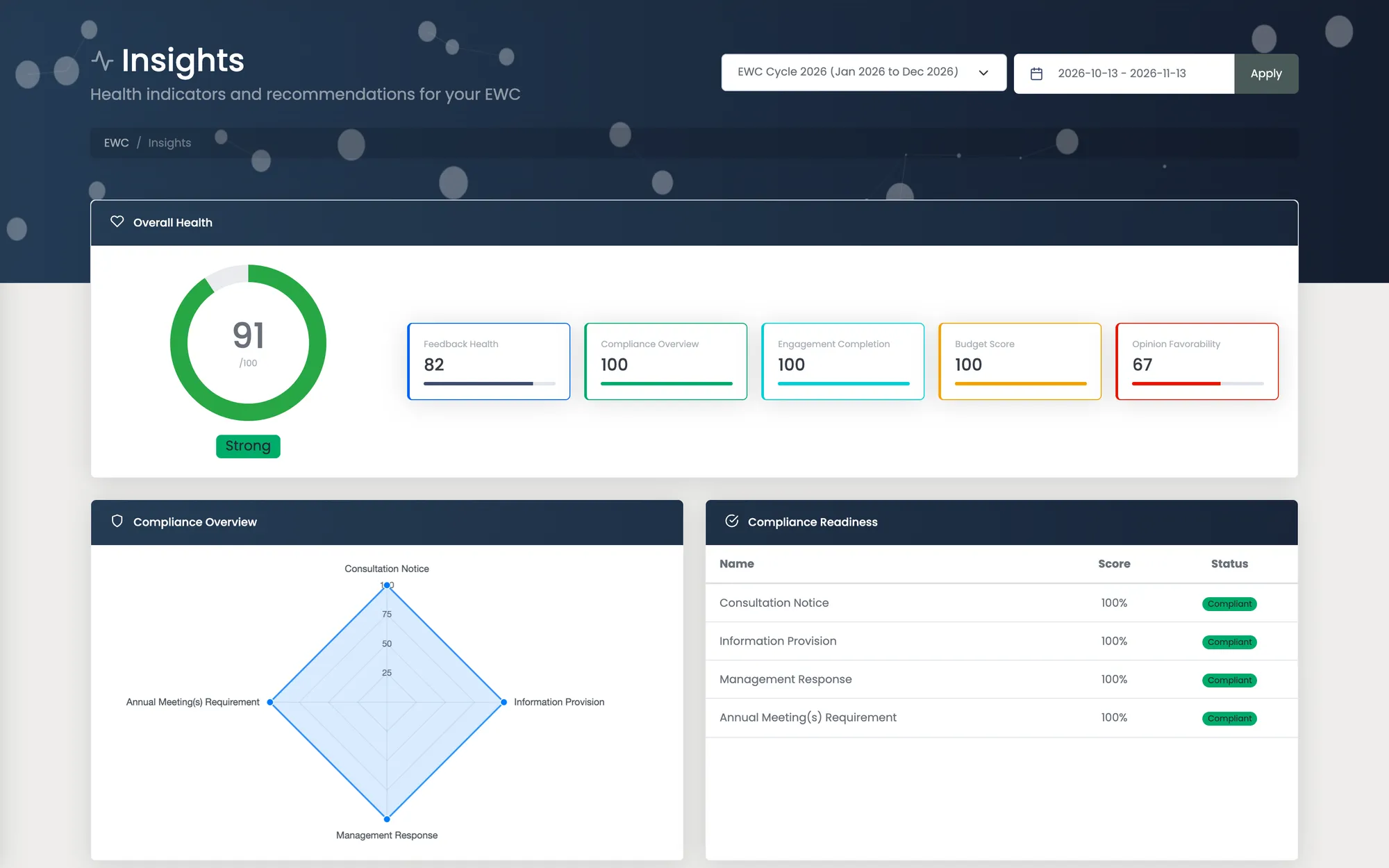
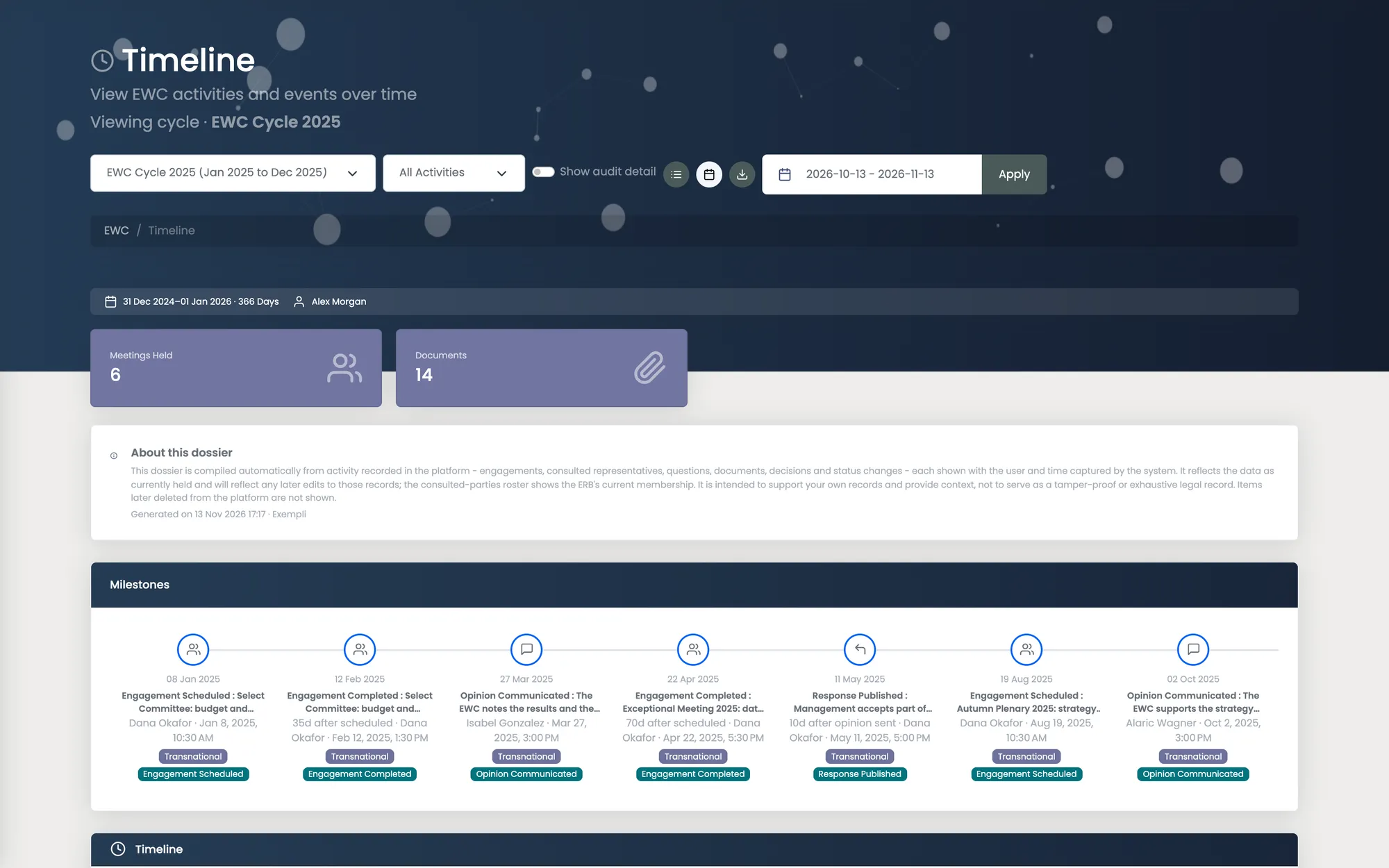
Graylark LRM is European Works Council software built for exactly this: agreements, meetings, information and consultation workflows, opinions and reasoned responses, and timeline evidence, in one multilingual platform. Book a demo to see what recast-ready looks like.
See it in Graylark.
Built for scrutiny.
Certified and tested
Cyber Essentials certified at Whole Organisation scope, and an independent penetration test of the platform in 2026.
Data inside the EEA
Stored and processed within the European Economic Area, with a dedicated database for each customer.
AI that stays inside
Inference inside Graylark’s EEA environment, no external AI APIs in the customer-data path, and no training on customer data.
Ready for procurement
The security pack, the Data Processing Agreement and the penetration test report are standing documents, sent the same day your security team asks.